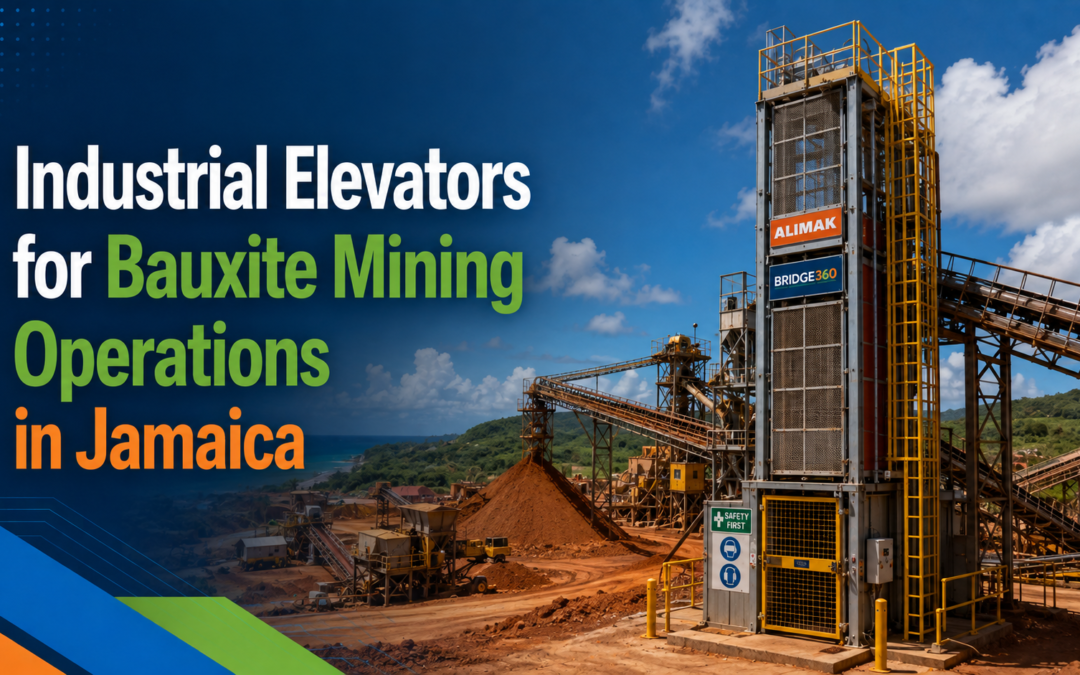
Industrial elevators for bauxite mining operations in Jamaica must be specified for abrasive dust, vibration, heavy-duty cycles, payload requirements, outdoor exposure and safe maintenance access. The right system helps mining and processing teams move personnel, tools and components across crushers, conveyors, silos, transfer towers, processing structures and elevated maintenance areas.
Jamaica has a long and important connection with bauxite mining and alumina production. According to the Mines and Geology Division of Jamaica, bauxite continues to dominate the country’s metallic mineral production. That makes reliable industrial access a practical concern for mines, processing plants and port-connected bauxite operations.
In mining environments, vertical access cannot be evaluated like a standard commercial elevator. Bauxite operations involve abrasive material, dust, heavy components, vibration, outdoor structures and maintenance work at height.
Bridge360 provides Alimak industrial elevator solutions for harsh Caribbean environments, including mining and heavy industrial operations that need reliable rack-and-pinion access for personnel, tools and materials.
For broader industrial and construction access support across the island, visit Bridge360’s Jamaica vertical access solutions page.
Quick answer
Bauxite mining operations in Jamaica need industrial elevators designed for abrasive dust, vibration, heavy loads, outdoor exposure and maintenance access at height. Rack-and-pinion Alimak elevators such as the Alimak SE or SE-H can support safer access to crushers, conveyors, silos, transfer towers and processing structures.
Who should use this guide?
This guide is for mining operators, plant managers, maintenance leaders, HSE teams, project engineers and procurement teams evaluating vertical access for bauxite mining and alumina-related industrial facilities in Jamaica.
It is especially useful if your team needs to evaluate:
- Permanent industrial elevators for mining operations.
- Access to crushers, conveyors and processing structures.
- Safer movement of maintenance teams.
- Personnel and material transport.
- Elevator specifications for dusty mining environments.
- Heavy-duty configurations for tools and components.
- Reduced dependence on ladders or temporary access.
- Long-term maintenance and spare parts planning.
- Regional support for Caribbean mining operations.
Why vertical access matters in bauxite mining operations
Vertical access matters in bauxite mining because inspection, maintenance, repair and operational support often happen at height.
Maintenance teams may need to reach crushers, conveyors, transfer points, silos, loading systems, processing equipment, elevated platforms and plant structures. When access is slow or unsafe, maintenance becomes harder to schedule and operational delays become more expensive.
Common access challenges in bauxite mining include:
- Reaching elevated structures safely.
- Moving tools and spare parts between levels.
- Reducing ladder and stair climbing.
- Supporting preventive maintenance.
- Improving inspection access.
- Reducing worker fatigue.
- Maintaining access during shutdown windows.
- Keeping critical equipment reachable in dusty conditions.
- Supporting emergency or corrective maintenance.
In Jamaica, these challenges are especially relevant because bauxite mining and alumina-related operations remain part of the country’s industrial landscape. The Jamaica Bauxite Institute provides useful context on the development and structure of Jamaica’s bauxite and alumina industry, including mining, processing and transport operations.
Why bauxite mining needs specialized industrial elevators
Bauxite mining operations need specialized industrial elevators because the environment is harsher than a typical commercial or residential building.
A commercial elevator is usually designed for clean, controlled environments. Mining operations are different.
They may include:
- Abrasive bauxite dust.
- Vibration from crushers and conveyors.
- Outdoor exposure.
- Heavy tools and replacement parts.
- Elevated process structures.
- Frequent maintenance cycles.
- Harsh cleaning and operating conditions.
- Limited shutdown windows.
- Remote or difficult access points.
- Heavy-duty personnel and freight movement.
Alimak describes mining as a demanding environment where industrial elevators may need to support underground mines, open-pit mines, processing plants, smelters, concentrators and other heavy-duty mining applications. This reinforces why elevator selection in bauxite operations should begin with operating conditions, not only with cabin size or speed.
What makes an elevator suitable for bauxite mining environments?
An industrial elevator suitable for bauxite mining should match the site’s dust exposure, vibration level, payload requirements, travel height, duty cycle, installation layout and maintenance strategy.
The main factors to evaluate are:
- Dust exposure: Bauxite dust can affect exposed components, electrical systems, doors, landings and maintenance requirements.
- Vibration: Crushers, conveyors and processing equipment can create demanding conditions around the installation area.
- Payload capacity: Teams may need to move personnel, tools, replacement parts and heavy components.
- Travel height: Transfer towers, silos and processing structures may require reliable access across multiple levels.
- Duty cycle: Mining maintenance and inspection routes may require frequent use.
- Installation layout: Mining plants often have existing structures, tight spaces and complex access points.
- Maintenance support: Downtime can affect production, repairs, safety inspections and operational continuity.
For Jamaican bauxite mining operations, these factors should be reviewed before selecting the elevator model.
Why rack-and-pinion technology fits mining environments
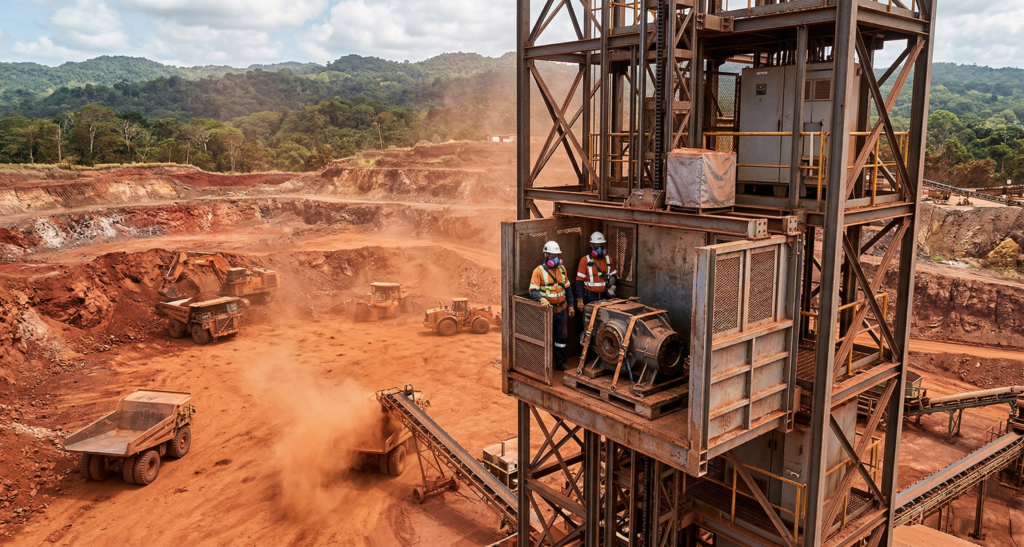
Rack-and-pinion elevators use a motorized pinion gear that travels along a fixed rack attached to the mast. This system eliminates the need for conventional traction cables and a separate machine room, making it useful in mining structures where dust, vibration, outdoor exposure and space constraints matter.
For bauxite mining operations, rack-and-pinion technology can support:
- Outdoor industrial installations.
- Access to crushers and transfer towers.
- Heavy-duty personnel and material transport.
- Flexible installation on existing structures.
- Reduced dependence on traditional elevator shafts.
- Reliable access for maintenance and inspection.
- Long-term operation in dusty industrial settings.
This makes rack-and-pinion systems a strong fit for mining sites that need rugged vertical access without relying on commercial elevator assumptions.
Alimak SE: industrial access for mining maintenance routes
The Alimak SE is a modular industrial elevator designed for passenger and freight movement in demanding facilities.
For bauxite mining operations, it can support access to elevated platforms, conveyors, inspection areas, silos and process structures.
The Alimak SE should be considered when a facility needs:
- Permanent industrial access.
- Personnel and material transport.
- Reliable movement between multiple levels.
- A rack-and-pinion system for harsh environments.
- A modular solution for different mining structures.
- Support for maintenance and inspection teams.
For mining operations in Jamaica, the Alimak SE can be a strong direction when the required payload is within the standard industrial range and the main goal is reliable daily access for people, tools and lighter components.
Alimak SE-H: heavy-duty access for larger mining loads
The Alimak SE-H is designed for heavier industrial transport requirements.
It can be relevant when a mining or processing facility needs to move larger tools, heavy replacement parts, maintenance equipment or multiple personnel in one trip.
The Alimak SE-H should be considered when the facility requires:
- Higher payload capacity.
- Heavy-duty industrial access.
- Transport of tools and replacement parts.
- Access to large processing structures.
- Reliable operation in dusty, high-duty environments.
- A stronger configuration for long-term industrial use.
- Support for mining, smelting or heavy manufacturing environments.
For bauxite mining and alumina-related operations where maintenance teams frequently move heavy components between levels, the SE-H may be more appropriate than a lighter industrial configuration.
Alimak SE or SE-H: which one fits a bauxite mining operation?
Choose Alimak SE when the site needs modular personnel and material access for regular maintenance routes, inspection platforms, conveyors or elevated process areas.Choose Alimak SE-H when the facility needs higher payload capacity for heavier tools, replacement parts, maintenance equipment or larger industrial components.
The final recommendation should be based on payload, travel height, number of landings, dust exposure, vibration, installation layout and maintenance frequency.
Recommended Alimak direction by mining application
For crusher access, the main challenge is vibration, dust and maintenance access. Depending on payload and structure layout, the project may require Alimak SE or Alimak SE-H.
For conveyor transfer points, the main challenge is reaching elevated mechanical systems safely. Alimak SE can support personnel and tool movement when the payload and layout fit the project requirements.
For silos and storage structures, the main challenge is height, dust exposure and inspection access. The elevator should be selected according to travel height, number of landings, payload and maintenance frequency.
For processing plants, the main challenge is repeated access to elevated equipment, platforms and maintenance routes. A heavier-duty configuration such as Alimak SE-H may be appropriate when the plant needs to move larger parts or maintenance teams.
For port-connected bauxite operations, the main challenge is maintaining access across logistics, loading or transfer infrastructure exposed to dust, salt air and outdoor conditions.
For temporary repairs, shutdown work or plant expansion, Bridge360 can also support construction hoist solutions when a permanent elevator is not the right fit.
Why dust changes the elevator specification
Dust is one of the main reasons mining operations should avoid treating vertical access like a standard building elevator decision.
Bauxite dust can settle on exposed parts, enter openings, affect electrical cabinets, increase cleaning requirements and make maintenance access more difficult.
A mining elevator specification should consider:
- Electrical cabinet protection.
- Dust exposure around landings.
- Cleaning access.
- Door and landing durability.
- Component accessibility.
- Preventive maintenance requirements.
- Safe access for inspections.
- Long-term spare parts planning.
The objective is not only to install an elevator. The objective is to maintain reliable vertical access in an environment where dust is part of daily operation.
Why bauxite dust changes the access strategy
Bauxite dust can settle on exposed parts, enter openings, affect electrical cabinets and increase cleaning requirements. For this reason, elevator planning in a mining operation should consider dust exposure, landing protection, component accessibility, maintenance intervals and long-term spare parts availability.
Why vibration matters in mining elevator planning
Vibration is another important factor in bauxite mining environments.
Crushers, conveyors, transfer points and processing equipment can create vibration near the access structure. If the elevator is not specified for the operating environment, vibration can affect long-term reliability, maintenance frequency and component wear.
A bauxite mining operation should evaluate:
- Distance from crushers and vibrating equipment.
- Structural support conditions.
- Landing stability.
- Mast attachment points.
- Frequency of nearby equipment operation.
- Inspection access.
- Maintenance intervals.
- Long-term wear management.
Vibration should not be treated as a minor detail. In mining, it is part of the access strategy.
Why outdoor exposure matters in Jamaica
Outdoor exposure matters because mining and processing infrastructure can be exposed to heat, humidity, rain, dust and coastal conditions depending on the site.
For vertical access systems, outdoor exposure can affect exposed steel components, fasteners, mast sections, landings, doors, platforms and electrical systems.
A Jamaican bauxite operation should evaluate:
- Outdoor installation points.
- Rain and water exposure.
- Dust accumulation.
- Heat and humidity.
- Coastal or port exposure.
- Protective coatings.
- Drainage.
- Inspection access.
- Preventive maintenance requirements.
Protection against environmental wear should be part of the elevator’s lifecycle strategy, not an afterthought.
Jamaica specification note
For bauxite mining operations in Jamaica, elevator planning should consider dust, vibration, humidity, outdoor exposure and payload from the beginning. These factors influence model selection, corrosion protection, maintenance planning, spare parts strategy and long-term access reliability.
Local context: bauxite mining in Jamaica
Jamaica’s bauxite sector gives this topic a strong local industrial context. The Mines and Geology Division reported that Jamaica produced approximately 5.99 million tonnes of bauxite in 2023, with part of that output processed as crude bauxite and exported from Discovery Bay mines.
The Jamaica Bauxite Institute also documents the historical and operational relevance of bauxite and alumina in Jamaica, including mining and alumina processing operations in locations such as St. Ann and Nain.
For mining operators, this means vertical access planning is not a theoretical issue. It is connected to real operational environments where maintenance routes, elevated structures, conveyors, processing equipment and logistics infrastructure must remain accessible.
Why maintenance planning should start before installation
Maintenance planning should start before installation because mining elevators operate in difficult environments.
Dust, vibration, humidity, outdoor exposure and heavy-duty operation can increase the importance of preventive maintenance and inspections.
A strong maintenance plan should include:
- Preventive maintenance intervals.
- Safety device checks.
- Inspection of mast sections and fasteners.
- Door and landing inspections.
- Electrical cabinet checks.
- Cleaning and dust-control procedures.
- Vibration-related inspection points.
- Genuine spare parts planning.
- Technician mobilization planning.
- Post-storm inspection procedures.
- Documentation for plant safety teams.
Bridge360 provides maintenance services to help extend the service life of Alimak systems, reduce downtime risk and support safe operation in Caribbean environments.
What buyers should evaluate before selecting a mining elevator
Before selecting an industrial elevator for a bauxite mining operation, buyers should evaluate both the operating environment and the maintenance strategy.
Important questions include:
- What structures need vertical access?
- What travel height is required?
- How many landings are needed?
- Will the elevator carry personnel, tools, components or all three?
- What is the maximum payload?
- How dusty is the operating environment?
- Is the elevator near crushers, conveyors or vibrating equipment?
- Is the elevator indoor, outdoor or coastal?
- What corrosion protection is required?
- How often will the elevator operate?
- What shutdown windows are available for installation?
- What maintenance access is currently unsafe or inefficient?
- What spare parts and service support will be available locally or regionally?
The wrong question is: “Which elevator is the cheapest?”
The better question is:
Which elevator will keep mining access safe, reliable and available with the lowest downtime risk?
What information should you send before requesting a consultation?
To help Bridge360 recommend the right Alimak configuration, share as much technical context as possible before the first consultation.
Useful information includes:
- Facility type.
- Project location in Jamaica.
- Structure type: crusher, conveyor, silo, tower, platform or processing plant.
- Required payload.
- Travel height.
- Number of landings.
- Indoor, outdoor or coastal exposure.
- Dust intensity.
- Vibration exposure.
- Personnel-only or personnel-and-material transport.
- Available power supply.
- Existing structure or new build.
- Maintenance schedule.
- Shutdown window.
- Required documentation.
- Project timeline.
This information helps the technical team evaluate whether the project requires Alimak SE, SE-H or another vertical access configuration.
Before requesting a consultation, prepare this information
Prepare the structure type, required payload, travel height, number of landings, dust intensity, vibration exposure, outdoor conditions, transport requirements, shutdown window, installation timeline, maintenance frequency and spare parts needs before requesting a consultation.
When should a mining operation choose a permanent industrial elevator instead of temporary access?
A bauxite mining operation should consider a permanent industrial elevator when elevated access is needed repeatedly for inspections, maintenance, operation support or movement of tools and components.
Temporary access may be useful for shutdown work, equipment replacement or construction phases, but it may not solve daily access needs.
A permanent industrial elevator can make more sense when:
- Maintenance teams access the same structure frequently.
- Ladder climbing creates safety or fatigue concerns.
- The facility has multiple elevated landings.
- Tools and parts need to move regularly.
- Downtime windows are limited.
- The site needs a long-term access solution.
- Inspection and maintenance routes must stay available year-round.
- Heavy components need to be moved more efficiently.
For temporary repairs, shutdown work or expansion projects, Bridge360 can evaluate whether a construction hoist is more appropriate than a permanent industrial elevator.
How Bridge360 supports bauxite mining vertical access projects
Bridge360 supports bauxite mining vertical access projects by helping teams evaluate the facility, select the right Alimak configuration and maintain the system over its lifecycle.
Support can include:
- Site assessment.
- Model recommendation.
- Payload and travel height planning.
- Dust exposure review.
- Vibration exposure review.
- Outdoor and corrosion exposure review.
- Installation coordination.
- Documentation support.
- Maintenance planning.
- Spare parts coordination.
- Technician mobilization.
- Long-term service support.
Bridge360’s goal is not simply to supply an elevator. The goal is to help mining and processing teams keep people, tools and components moving safely in environments where downtime is expensive and reliability is essential.
Request an industrial elevator consultation for bauxite mining in Jamaica
If your facility operates in Jamaica’s bauxite mining, alumina processing or heavy industrial sector, choosing the right elevator starts with a technical review.
Bridge360 can help you evaluate payload, travel height, dust exposure, vibration, duty cycle, maintenance needs and regional support planning.
For a broader view of Bridge360’s support across mining, industrial, logistics and infrastructure applications in Jamaica, visit the Jamaica vertical access solutions page.
Request an Industrial Elevator Consultation
Need to evaluate vertical access for a bauxite mining operation in Jamaica?
Bridge360 can help your team review payload, travel height, dust exposure, vibration, number of landings and maintenance needs before selecting the right Alimak industrial elevator configuration.
Frequently asked questions about industrial elevators for bauxite mining in Jamaica
What type of elevator is used in bauxite mining operations?
Bauxite mining operations often use industrial elevators designed for dusty, high-duty and heavy-load environments. Rack-and-pinion elevators such as the Alimak SE or SE-H can support access to crushers, conveyors, silos, transfer towers and processing structures.
Why are commercial elevators not ideal for mining operations?
Commercial elevators are usually designed for cleaner, controlled buildings. Mining operations expose equipment to abrasive dust, vibration, outdoor conditions, heavy components and frequent maintenance cycles, which require a more rugged industrial elevator specification.
Why is Alimak SE relevant for bauxite mining in Jamaica?
The Alimak SE is relevant because it provides modular industrial vertical access for personnel and materials in demanding environments. It can support maintenance teams that need reliable access to elevated structures, conveyors and process areas.
When should a mining operation choose Alimak SE-H?
A mining operation should consider Alimak SE-H when the project requires higher payload capacity, heavy tools, larger components or more demanding transport requirements than a standard industrial elevator configuration.
How does bauxite dust affect industrial elevators?
Bauxite dust can settle on exposed components, enter openings, affect electrical cabinets and increase maintenance requirements. Elevator planning should consider dust exposure, cleaning access, component accessibility and preventive maintenance intervals.
Can a mining site use a construction hoist instead of an industrial elevator?
A construction hoist can be useful for temporary access during construction, repair or shutdown work. A permanent industrial elevator is usually more appropriate when the site needs long-term, repeated access for operations, inspections and maintenance.
Can Bridge360 support bauxite mining projects in Jamaica?
Yes. Bridge360 supports vertical access projects across the Caribbean, including Jamaica, with Alimak industrial elevators, construction hoists, maintenance services and regional support.
What information should I provide before requesting a consultation?
Useful information includes facility type, structure height, required payload, number of landings, dust exposure, vibration exposure, installation constraints, maintenance needs, power availability and project timeline.