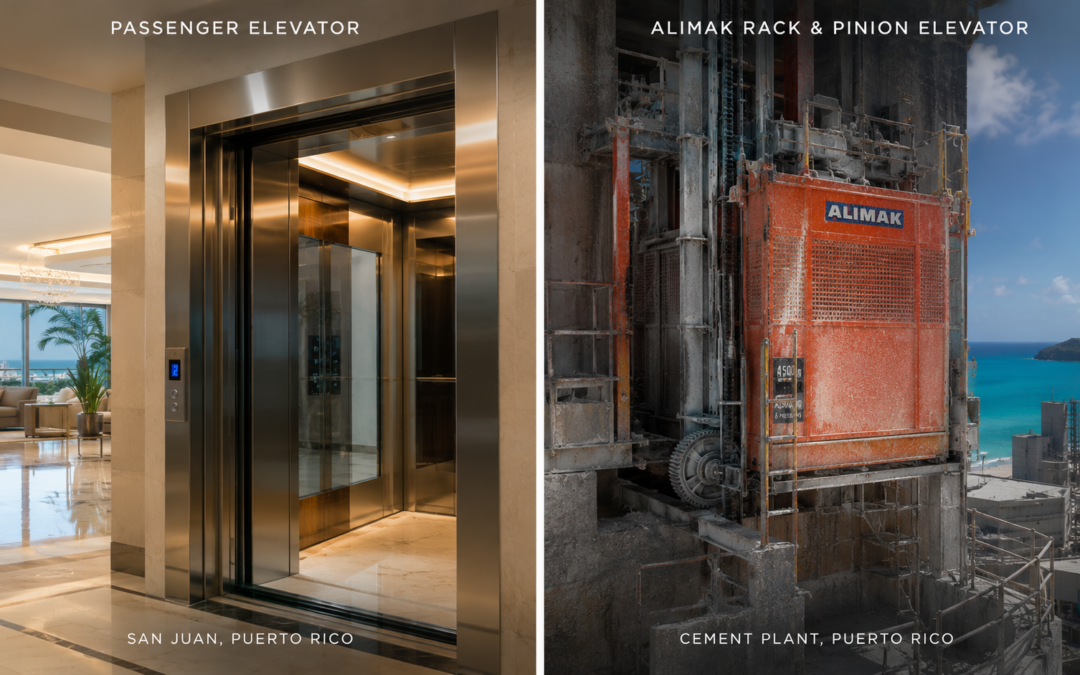
Industrial elevators are built for harsh, high-duty and hazardous facilities, while commercial elevators are built for passenger movement in controlled buildings. For Caribbean mines, ports, cement plants, power plants and oil & gas operations, the decision should depend on load capacity, corrosion exposure, duty cycle, safety classification and service access.
A commercial elevator can move people inside an office, hotel or residential building. An industrial elevator must move people, tools and materials inside environments where salt air, abrasive dust, heat, vibration, heavy loads and continuous operation create real operational risk.
Bridge360 provides certified Alimak vertical access solutions in the Caribbean, including industrial elevators, construction hoists and maintenance services for demanding industrial and construction environments. Bridge360 presents its industrial elevators as purpose-built rack and pinion solutions for harsh Caribbean conditions where conventional elevators can fail due to salt air, abrasive dust and continuous production demands. (Bridge360)
What is the difference between an industrial elevator and a commercial elevator?
The difference is the operating environment. A commercial elevator prioritizes passenger comfort, aesthetics, building traffic and interior access. An industrial elevator prioritizes uptime, rated load, corrosion resistance, service access, safety systems and long-term operation in harsh facilities.
Commercial elevators are commonly used in offices, hotels and residential buildings. Industrial elevators are specified for facilities such as mines, ports, cement plants, power plants, offshore platforms and heavy industrial sites, where vertical access is part of the production system.
In the Caribbean, this distinction matters because the elevator is not only moving passengers. It may be moving maintenance crews, replacement parts, inspection tools, production materials or emergency access personnel inside facilities that cannot afford unplanned downtime.
For this reason, Bridge360 offers Alimak industrial elevators built for harsh environments, including equipment designed for ports, mining, power plants, cement facilities and heavy-duty operations.
Why is using a commercial elevator specification risky in Caribbean industrial facilities?
The main risk is specifying the elevator around building height and cabin size instead of duty cycle, environment and load. That mistake can produce a system that looks acceptable on paper but fails under salt, dust, humidity and continuous use.
In Caribbean industrial environments, conventional cable-driven elevators can be vulnerable because steel cables may stretch or corrode in high-salinity air, while abrasive dust from bauxite, grain or cement can infiltrate complex machine rooms and contribute to premature failure. (Bridge360)
The specification should begin with five questions:
- Identify the maximum rated load in kilograms.
- Confirm the number of daily operating cycles.
- Define the exposure to salt, dust, heat, moisture or chemicals.
- Verify if the area requires hazardous-location or explosion-protected equipment.
- Confirm how fast technicians and spare parts can reach the site.
This is the practical difference between a passenger elevator decision and an industrial access decision.
Which real data should buyers compare before choosing an elevator?
Buyers should compare payload, environment, regulatory scope, service access and industry risk.
Bridge360’s industrial elevator portfolio includes several Alimak models for different applications. The Alimak SE is presented for demanding applications such as power plants, cement plants and manufacturing, with a capacity range of 300–2,000 kg. The Alimak SE-H is positioned for heavy mining, smelters and large infrastructure, with a listed capacity range of 2,000–7,000 kg. The Alimak FM is positioned for offshore platforms, ship-to-shore cranes and shipyards, with a listed capacity range of 5,000–12,000 kg. (Bridge360)
For Caribbean projects, the local industrial context matters. Jamaica produced approximately 5.99 million tonnes of bauxite in 2023, making mining and alumina operations a clear use case for heavy-duty vertical access. (Mines and Geology Division) Trinidad and Tobago’s oil and gas sector accounted for 29.8% of GDP and 81% of export earnings in 2022, which makes operational uptime a major economic priority for industrial facilities. (International Trade) In Puerto Rico, fossil-fuel power plants provided 93% of electricity generating capacity in 2024, which reinforces the need for reliable access in power generation and critical infrastructure. (EIA)
Real-world comparison: industrial elevator vs commercial elevator
| Factor | Commercial Elevator | Industrial Elevator |
|---|---|---|
| Primary use | Passenger movement in controlled buildings | Personnel, tools, freight and maintenance access in demanding environments |
| Typical locations | Offices, hotels, residential buildings, malls | Mines, ports, cement plants, power plants, oil & gas facilities, offshore platforms |
| Main priority | Comfort, aesthetics and passenger traffic | Uptime, safety, rated load, durability and serviceability |
| Environmental exposure | Usually indoor and controlled | Salt air, dust, heat, humidity, vibration, corrosive exposure and heavy-duty cycles |
| Load requirement | Mostly passenger-focused | Personnel, tools, equipment, replacement parts and heavy materials |
| Specification focus | Building traffic, cabin size and passenger comfort | Duty cycle, payload, safety classification, corrosion resistance and maintenance access |
| Example equipment | Standard passenger elevator | Alimak SE, Alimak SE-H, Alimak FM and other industrial vertical access systems |
| Best fit | Commercial buildings | Caribbean industrial and construction environments |
When should a facility choose an industrial elevator instead of a commercial elevator?
A facility should choose an industrial elevator when vertical access affects production, maintenance, safety or uptime. This applies when the elevator must operate outdoors, inside corrosive environments, near dust-generating processes or in hazardous zones.
Industrial elevators are usually the better choice when the site includes heavy equipment, bulk materials or elevated assets that require frequent technical access.
A commercial elevator may be enough for controlled passenger movement. An industrial elevator becomes necessary when the system must support real operational continuity.
For facilities comparing options, Bridge360’s industrial elevator solutions help define the correct system based on environment, load requirements, hazardous classifications and duty cycle.
When does a mining operation need an industrial elevator?
A mining operation needs an industrial elevator when maintenance crews, tools or replacement parts must reach elevated conveyors, silos, crushers, processing equipment or structural platforms.
In Jamaica, bauxite and alumina operations create a clear use case because dust, height, material movement and production continuity are part of the operating environment. Jamaica’s mining data reported approximately 5.99 million tonnes of bauxite production in 2023. (Mines and Geology Division)
Bridge360’s page for vertical access solutions in Jamaica identifies bauxite mining, alumina, cement, construction, data centers, logistics and energy as key sectors that require rugged vertical access. (Bridge360)
For this type of operation, the elevator should not be selected only by cabin size. It should be selected by payload, operating cycles, dust exposure, structural requirements, maintenance access and long-term service planning.
When does an oil and gas facility need an industrial elevator?
An oil and gas facility needs an industrial elevator when vertical access is required in refineries, offshore platforms, marine terminals, process units or hazardous areas.
For oil and gas environments, the elevator decision should consider safety classification, corrosion exposure, emergency access and equipment reliability.
Bridge360 offers the Alimak SE-Ex for hazardous environments, making it a relevant option for energy, refineries, offshore platforms and facilities where explosion-protected access may be required. Bridge360 describes the SE-Ex as engineered for industries where flammable gases, vapors or combustible dust create explosion risk. (Bridge360)
For companies operating in Trinidad and Tobago, Bridge360 provides vertical access solutions for oil and gas, heavy industry, ports and marine operations, where corrosion resistance, hazardous-area planning and uptime are critical.
When does a power plant need an industrial elevator?
A power plant needs an industrial elevator when technicians must access boilers, chimneys, turbine areas, elevated platforms, monitoring stations or emergency systems.
Power generation sites require dependable vertical access because downtime can affect essential services, industrial operations and critical infrastructure.
For this type of facility, the right question is not only “how many floors does it need to travel?” The better question is “what access system keeps technicians moving safely when the plant needs maintenance?”
For facilities in Puerto Rico, Bridge360 provides vertical access solutions for data centers, ports and power generation, where resilience, storm readiness and compliance are essential to critical infrastructure planning.
Why does rack and pinion technology matter for industrial elevators?
Rack and pinion technology matters because the drive system is built around a mast and mechanical engagement instead of depending on a conventional passenger-elevator configuration.
Bridge360 explains that Alimak elevators do not use cables. They operate on a rack and pinion system mounted directly on the mast, eliminating the need for a separate machine room and supporting performance in wet, dusty and corrosive conditions. (Bridge360)
For industrial buyers, this matters because service access, mechanical simplicity, load handling and environmental resistance can have a direct effect on uptime.
Facilities that need smaller permanent access systems can review the Alimak SL, while facilities requiring heavy-duty material and personnel transport can compare the Alimak SE, Alimak SE-H and Alimak FM.
How should Caribbean buyers compare elevator options by country?
Buyers should compare elevator options by country using industry risk, environmental exposure and service logistics. The same elevator configuration may not be ideal for a bauxite facility in Jamaica, an offshore platform in Trinidad and Tobago, a cement plant in Barbados and a power generation site in Puerto Rico.
Bridge360 supports multiple Caribbean markets through its regional hub, with country pages for Jamaica, Trinidad and Tobago, Barbados and Puerto Rico.
What should buyers in Jamaica evaluate?
Buyers in Jamaica should evaluate dust exposure, bauxite-related material handling, uptime requirements, elevated maintenance access and spare parts availability.
Strong candidates include industrial elevators for mining, cement, logistics and data center facilities.
Bridge360’s Jamaica solutions page highlights bauxite mining, alumina, cement, construction, data centers, logistics and energy applications.
What should buyers in Trinidad and Tobago evaluate?
Buyers in Trinidad and Tobago should evaluate hazardous-area requirements, offshore or marine exposure, corrosion resistance, explosion-protected options and emergency access planning.
Strong candidates include explosion-protected elevators, offshore freight elevators and heavy-duty service elevators for oil and gas assets.
Companies operating in this market can review Bridge360’s vertical access solutions for Trinidad and Tobago when evaluating industrial elevators for oil and gas, heavy industry, ports and marine operations.
What should buyers in Barbados evaluate?
Buyers in Barbados should evaluate cement dust, salt air, port access, limited-space installation and preventive maintenance planning.
Strong candidates include compact industrial elevators, cement plant access systems and maintenance-focused retrofit solutions.
For facilities in Barbados, Bridge360 provides vertical access solutions for cement plants, port services and infrastructure projects in Barbados, where salt air, dust exposure and limited downtime windows require durable industrial elevator systems.
What should buyers in Puerto Rico evaluate?
Buyers in Puerto Rico should evaluate power generation access, data center reliability, port logistics, storm readiness and the ability to support critical infrastructure.
Strong candidates include industrial elevators for power plants, ports, data centers and infrastructure facilities.
Bridge360’s Puerto Rico vertical access solutions support industrial access needs for data centers, ports, power generation and infrastructure projects.
What role does maintenance play in industrial elevator performance?
Maintenance plays a direct role in uptime, safety and long-term operating cost. An industrial elevator should not be treated as a one-time equipment purchase. It should be managed as a full-lifecycle access system.
Bridge360’s maintenance and services support should be part of the selection process because industrial elevators operate in environments where downtime can stop inspections, delay production, interrupt vessel operations or increase safety exposure.
Bridge360 replaces the break-fix model with preventive maintenance plans and provides rapid deployment of certified technicians and parts from its Caribbean hub. (Bridge360)
A proper maintenance plan should include inspections, preventive service, genuine parts, technician response time, safety checks and long-term modernization planning.
What questions should buyers ask before requesting an industrial elevator consultation?
Buyers should ask technical questions before selecting any elevator model. The goal is to avoid under-specifying the system and creating future downtime.
- Define the maximum passenger and material load.
- Confirm the required number of landings.
- Identify indoor, outdoor, marine, dusty or corrosive exposure.
- Verify whether the facility needs hazardous-area protection.
- Calculate daily usage cycles and peak operating periods.
- Confirm available power supply and site restrictions.
- Review applicable elevator codes, inspection needs and maintenance requirements.
- Plan spare parts access and technician response time.
OSHA 1926.552 states that employers must comply with manufacturer specifications and limitations for hoists and elevators, and that rated load capacities, recommended operating speeds and special hazard warnings must be posted on cars and platforms. (osha.gov) ASME A17.1 / CSA B44 is the accepted North American guide for the design, construction, installation, operation, inspection, testing, maintenance, alteration and repair of elevators, escalators and related conveyances. (SAIM)
The wrong question is: “What elevator fits this shaft?”
The better question is: “What vertical access system can keep this operation running safely for years?”
What does Bridge360 recommend for Caribbean industrial facilities?
“An industrial elevator should not be selected by cabin size alone. In Caribbean facilities, the engineering decision starts with duty cycle, corrosion exposure, rated load, safety classification and service response time.”
— Bridge360 Technical Team
This is why Bridge360 evaluates the complete operating context before recommending an Alimak industrial elevator. The consultation should define the load, environment, usage pattern, safety requirements, installation constraints and long-term service plan.
How can Bridge360 help you choose the right industrial elevator?
Bridge360 helps Caribbean facilities specify industrial elevators for demanding environments, including mining, cement, oil and gas, ports, power generation, data centers and heavy industry.
If your facility is comparing an industrial elevator vs a commercial elevator, request a consultation before choosing a system. A technical review can prevent under-specification, reduce downtime risk and align the elevator with your real operating conditions.
Request an Industrial Elevator Consultation
Frequently asked questions about industrial elevators vs commercial elevators
What is an industrial elevator?
An industrial elevator is a vertical access system designed for demanding facilities such as mines, cement plants, ports, power plants, refineries and offshore platforms. It prioritizes uptime, load capacity, durability, safety and serviceability. For more technical context, visit Bridge360’s industrial elevators page.
What is a commercial elevator?
A commercial elevator is a passenger-focused elevator used in buildings such as offices, hotels, hospitals, shopping centers and residential towers. It is typically designed for controlled environments and regular passenger traffic.
Can a commercial elevator be used in an industrial facility?
A commercial elevator should not be used in an industrial facility unless the environment, load, usage cycle and safety requirements match the manufacturer’s specifications and applicable code requirements. Industrial facilities should request a technical assessment before choosing between a commercial elevator and an industrial elevator solution.
Why are rack and pinion elevators used in industrial environments?
Rack and pinion elevators are used in industrial environments because they can provide durable vertical access for harsh, dusty, corrosive or high-duty applications. Bridge360’s Alimak portfolio includes options such as Alimak SE, Alimak SE-H, Alimak SE-Ex, Alimak SL and Alimak FM.
Which industries need industrial elevators in the Caribbean?
Caribbean industries that need industrial elevators include mining, cement, oil and gas, ports, marine operations, power generation, logistics, data centers and infrastructure. Bridge360 serves these industries across Jamaica, Trinidad and Tobago, Barbados and Puerto Rico.