
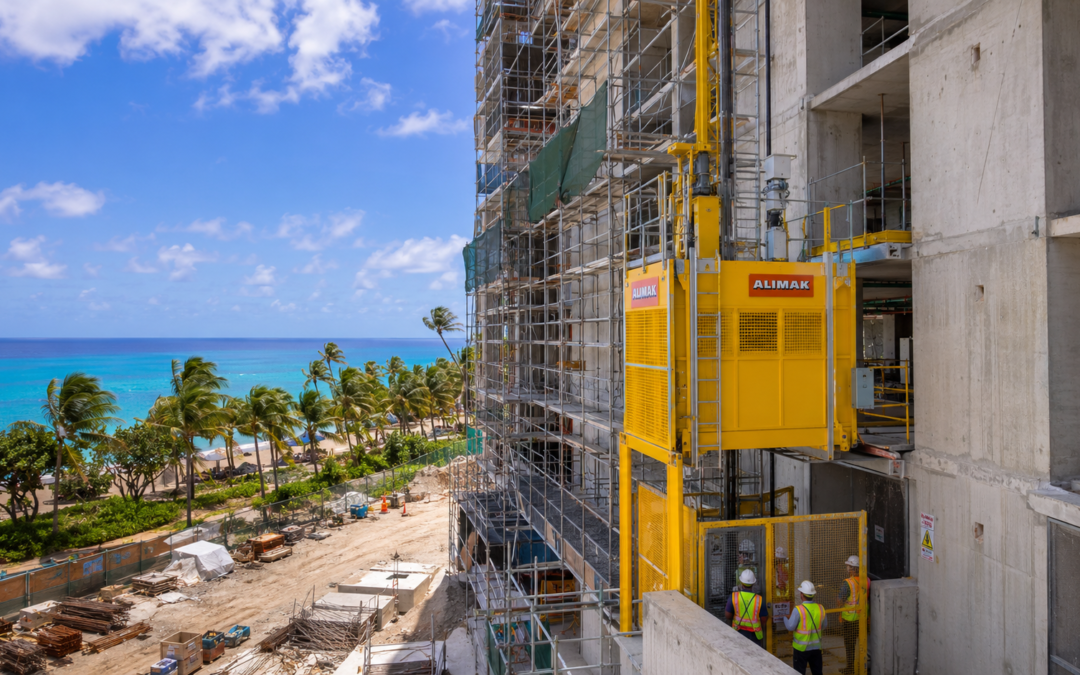
Construction hoist rental helps Caribbean contractors move crews, tools and materials faster on multi-story projects without overloading the tower crane. The right hoist should match the project height, payload, schedule, site layout, hurricane exposure, safety requirements and regional service support before installation begins.
On a high-rise job site, vertical logistics can become one of the most expensive bottlenecks. When workers wait for materials, when pallets stay on the ground, or when the tower crane is used for tasks a hoist could handle, the entire schedule slows down.
Bridge360 provides Alimak construction hoist solutions in the Caribbean for projects that need safe, efficient and temporary vertical access for personnel and materials. Its construction hoist portfolio includes options such as the Alimak Scando 650, Alimak Scando 450, Alimak SC Construction Hoist and Alimak LSH Construction Hoist. Bridge360 describes construction hoists as temporary rack and pinion systems used to move personnel and materials safely and efficiently on multi-story building projects. (Bridge360)
What is a construction hoist?
A construction hoist is a temporary vertical transport system used on construction sites to move workers, tools and materials between floors. It usually operates on a mast structure using a rack and pinion drive system.
Contractors often call it a personnel hoist, material hoist, buck hoist or construction elevator. The purpose is the same: create a dedicated vertical transport route that keeps crews and materials moving while freeing the tower crane for critical lifts.
On Caribbean projects, a construction hoist is especially important for hotels, resorts, hospitals, commercial towers, infrastructure projects and high-density developments where site delays can quickly become expensive.
When should contractors rent a construction hoist?
Contractors should rent a construction hoist when the project has a temporary vertical access need, a defined construction timeline and frequent movement of workers or materials across multiple levels.
Rental is usually the right decision when the hoist is needed only during construction and will be removed after the project is complete.
A construction hoist rental makes sense when:
- The project has several floors or elevated work areas.
- Crews lose time waiting for vertical transport.
- The tower crane is being used for small loads or crew-related movement.
- Materials need to move repeatedly between ground level and upper floors.
- The project schedule depends on parallel work across multiple levels.
- The site needs a safer and more controlled way to move personnel.
- The contractor wants temporary access without purchasing permanent equipment.
For this reason, Bridge360 offers construction hoist rental in the Caribbean for contractors who need vertical access without making a long-term equipment purchase.
Why does construction hoist rental matter for Caribbean projects?
Construction hoist rental matters because Caribbean projects face a combination of height, weather, logistics and regional service challenges.
A generic hoist decision can create delays if the equipment is not configured for the project’s payload, building height, tie-in points, available power, wind exposure and site logistics.
Bridge360’s construction hoist page explains the core problem clearly: when a tower crane is busy moving crews, blockwork or tools, it is not lifting steel, concrete or prefabricated components. A dedicated Alimak system works as a vertical “express lane” that moves crews and materials in parallel with tower crane operations. (Bridge360)
In the Caribbean, that productivity issue is intensified by regional conditions. Projects must account for salt air, tropical rain, wind exposure, port logistics, customs timing, hurricane season and the availability of certified technicians.
The Atlantic hurricane season officially runs from June 1 through November 30, according to the National Hurricane Center. That means vertical access planning in the Caribbean should consider storm-readiness procedures before the hoist is installed.
What should contractors evaluate before renting a construction hoist?
Contractors should evaluate six factors before renting a construction hoist: project height, payload, passenger volume, material dimensions, site layout and service response.
The hoist is not just an equipment rental. It is part of the project’s logistics plan.
1. Project height
The building height affects hoist speed, mast configuration, tie-in planning and installation sequence.
A low-rise project may not need the same configuration as a 30-story hotel or mixed-use tower. Taller buildings usually require better cycle-time planning because every trip consumes more time as the project rises.
2. Payload capacity
Payload capacity defines how much weight the hoist can carry in one trip.
This includes workers, tools, finishing materials, pallets, equipment and site supplies. Underestimating payload can increase trips, slow crews and create loading risks.
The Alimak Scando 650 range is designed for low-rise and high-rise construction projects, with capacities from 1,500 to 3,500 kg and maximum speeds up to 100 m/min, according to Alimak’s official product data. (Alimak)
Bridge360 also presents the Alimak Scando 650 as a high-speed, high-payload option for Caribbean construction projects, with payloads from 1,500 to 3,500 kg and customizable traveling speeds from 38 to 100 m/min. (Bridge360)
3. Passenger movement
A construction hoist is often used to move crews at the start and end of shifts.
If a project has multiple subcontractors working at different levels, passenger movement becomes a scheduling issue. The right hoist can reduce lost time by moving crews more consistently between active work zones.
4. Material dimensions
Weight is not the only issue. Size matters.
Drywall, glass panels, scaffolding frames, formwork, mechanical equipment and pallets may require longer car dimensions or specific door configurations.
Bridge360 notes that the Alimak Scando 650 can be configured with modular car sizes and long-side door options, making it easier to load oversized materials such as drywall pallets, glass panels and scaffolding frames. (Bridge360)
5. Site layout
Site layout affects where the hoist can be placed, how materials flow from storage areas and how crews access the building.
A poor hoist location can create ground-level congestion. A good hoist location reduces walking time, protects loading zones and supports better coordination between trades.
6. Service support
A construction hoist that is down is not only an equipment issue. It becomes a project delay.
Contractors should ask who installs the hoist, who maintains it, where spare parts are located and how fast technicians can respond.
Bridge360 provides site assessment, installation, certified inspections and maintenance as part of its full-service construction hoist support. (Bridge360)
Construction hoist rental comparison by project need
| Project Need | Recommended Hoist Direction | Why It Matters |
|---|---|---|
| High-rise hotel or resort | High-speed passenger and material hoist | Moves crews and materials faster across many floors |
| Mid-rise commercial building | Flexible mid-range hoist | Balances capacity, space and rental efficiency |
| Tight urban site | Compact or modular hoist configuration | Reduces site congestion and improves loading access |
| Project with early facade closure | In-shaft construction hoist | Allows exterior cladding and interior work to progress earlier |
| Heavy pallet movement | Higher-payload hoist | Reduces trip count and material waiting time |
| Facade or masonry work | Mast climbing work platform | Elevates workers and tools along the exterior work face |
| Bulky material movement only | Transport platform | Supports material logistics when personnel transport is not required |
Which Alimak construction hoist is right for your project?
The right Alimak construction hoist depends on the height, load, speed, shaft conditions, site space and project schedule. Bridge360’s construction hoist solutions include several options for different project conditions.
Alimak Scando 650: for high-rise speed and heavy payloads
The Alimak Scando 650 is a strong fit for high-rise projects where speed and capacity are critical.
It is designed to move personnel and materials efficiently on low-rise and high-rise construction projects. Alimak lists the Scando 650 range with a size of 1.5 m wide by 2.8–5.0 m long, a capacity of 1,500–3,500 kg and a maximum speed of 100 m/min. (Alimak)
This makes it a practical option for hotel towers, hospitals, commercial buildings and high-density resort projects where vertical logistics can directly affect the construction schedule.
Alimak Scando 450: for versatile mid-range projects
The Alimak Scando 450 is a practical option when the project needs flexibility but does not require the full high-speed, high-payload configuration of the Scando 650.
Bridge360 positions the Scando 450 as a versatile mid-range workhorse for sites with space constraints and modular car needs. Its construction hoist page describes it as an ideal balance of flexibility and power, with capacity up to 2,000 kg. (Bridge360)
Alimak SC Construction Hoist: for adaptable all-purpose use
The Alimak SC Construction Hoist is suited for projects that need robust all-purpose transport for personnel and materials.
Bridge360 presents the Alimak SC as an adaptable hoist with capacity up to 2,000 kg, proven reliability and low energy consumption. (Bridge360)
This type of hoist can be useful when the project needs dependable vertical transport but does not require the highest Scando 650 configuration.
Alimak LSH: for in-shaft construction logistics
The Alimak LSH Construction Hoist is designed to operate inside the building’s permanent elevator shaft during construction.
This can help contractors close the building envelope earlier because the hoist does not need to remain attached to the exterior facade until the end of the project.
Bridge360 describes the LSH as an in-shaft specialist that allows exterior cladding to move forward while personnel and materials continue moving inside the building. The LSH range is listed with payload capacity up to 2,000 kg and traveling speed up to 60 m/min. (Bridge360)
For Caribbean projects, this is especially relevant because exterior hoists can be affected by wind and rain. An internal hoist can protect vertical logistics from some exterior weather interruptions.
Mast climbing work platforms and transport platforms
Not every access problem requires a construction hoist.
For facade work, masonry or EIFS, mast climbing work platforms may be more efficient because they elevate the crew and tools along the work face.
For bulky material movement on lower-rise sites, transport platforms may support material logistics when personnel transport is not the main requirement.
The goal is not to rent the biggest hoist. The goal is to rent the right vertical access system for the job.
What safety requirements should contractors consider?
Contractors should consider manufacturer limits, posted load capacity, posted operating speed, hazard warnings, inspection records and competent-person oversight.
OSHA 1926.552 requires employers to comply with the manufacturer’s specifications and limitations for hoists and elevators. It also requires rated load capacities, recommended operating speeds and special hazard warnings or instructions to be posted on cars and platforms. (Seguridad y Salud Ocupacional)
OSHA also states that after assembly and erection, hoists must be inspected and tested before being put into service. Similar inspection and testing is required after major alteration, and hoists must be inspected and tested at intervals of not more than three months. (Seguridad y Salud Ocupacional)
This is why construction hoist rental should include installation support, inspection planning and ongoing maintenance. Equipment alone is not enough.
How does hurricane season affect construction hoist rental?
Hurricane season affects construction hoist rental because temporary vertical access equipment must be secured, inspected and managed before and after severe weather events.
The Caribbean sits inside the Atlantic hurricane basin, and the Atlantic hurricane season runs from June 1 through November 30.
For contractors, this means hoist planning should include:
- Storm preparation procedures.
- Emergency lowering or securing instructions.
- Power disconnection planning.
- Mast, tie-in and anchoring review.
- Post-storm inspection before returning to service.
- Coordination between the hoist provider, general contractor and safety team.
Bridge360’s Caribbean hurricane construction guide can support project teams that need to plan vertical access around severe weather risk.
What should contractors in Jamaica evaluate?
Contractors in Jamaica should evaluate project height, hotel construction timelines, bauxite-related logistics, resort development schedules, port access and regional service response.
For hotel and resort projects, construction hoist rental can help crews move finishing materials, tools and personnel without depending only on tower cranes or temporary stairs.
Bridge360 provides vertical access solutions for Jamaica, supporting sectors such as bauxite mining, alumina, cement, construction, data centers, logistics and energy. (Bridge360)
What should contractors in Trinidad and Tobago evaluate?
Contractors in Trinidad and Tobago should evaluate industrial site restrictions, port logistics, heavy construction needs, offshore-adjacent environments and corrosion exposure.
For large commercial or industrial projects, the hoist configuration should consider both construction productivity and the realities of working near marine and energy-sector environments.
Bridge360 provides vertical access solutions for Trinidad and Tobago for oil and gas, heavy industry, ports and marine operations.
What should contractors in Barbados evaluate?
Contractors in Barbados should evaluate salt air, limited site space, port access, infrastructure work and maintenance response.
For compact or coastal construction sites, the hoist decision should focus on loading access, tie-in planning, corrosion exposure and downtime prevention.
Bridge360 provides vertical access solutions for Barbados for cement plants, port services and infrastructure projects.
What should contractors in Puerto Rico evaluate?
Contractors in Puerto Rico should evaluate hurricane exposure, power availability, infrastructure schedules, ports, data centers and high-rise development needs.
For critical facilities, the hoist plan should include redundancy, service response and storm-readiness procedures.
Bridge360 provides vertical access solutions for Puerto Rico for data centers, ports, power generation and infrastructure projects.
How much does construction hoist rental cost?
Construction hoist rental cost depends on the hoist model, capacity, building height, rental duration, installation requirements, site location, freight, inspections, power setup, maintenance and removal.
A short project with a mid-range hoist will not have the same cost structure as a high-rise project that needs a high-speed Scando 650 configuration, longer mast height, multiple tie-ins and extended rental duration.
Contractors should avoid choosing a hoist based only on monthly rental price. The better calculation is the cost of delay avoided.
A properly configured hoist can reduce waiting time, improve material flow and free the tower crane for higher-value lifts.
What information should contractors provide before requesting a consultation?
Contractors should provide project details before requesting a construction hoist rental consultation. The most useful information includes:
- Project location.
- Building height.
- Number of floors.
- Expected rental duration.
- Required payload.
- Estimated crew size.
- Main materials to be transported.
- Site layout or logistics plan.
- Available power supply.
- Preferred installation date.
- Hurricane or weather-related constraints.
- Need for personnel transport, material transport or both.
- Required certifications or inspection requirements.
With this information, Bridge360 can recommend the right hoist configuration and support plan.
Why rent a construction hoist from Bridge360?
Bridge360 is not only an equipment provider. It supports the complete vertical access process for Caribbean projects. That process can include:
- Site assessment.
- Hoist configuration.
- Logistics planning.
- Regional mobilization.
- Certified installation.
- Safety coordination.
- Preventive maintenance.
- Technical support.
- Dismantling and removal.
Bridge360 emphasizes rapid regional deployment from its Dominican Republic hub to markets such as Jamaica, Trinidad and Tobago and Barbados, helping contractors avoid delays caused by distant service providers or unavailable spare parts. (Bridge360)
For contractors, this matters because a construction hoist rental is only valuable when it keeps working.
When should you request a construction hoist rental consultation?
Contractors should request a construction hoist rental consultation before the project reaches the stage where vertical logistics are already slowing down the schedule.
The best time is during pre-construction planning, before tower crane strategy, facade sequencing, material staging and site access routes are finalized. Early planning helps define:
- Where the hoist should be placed.
- What capacity the project needs.
- How fast the hoist should travel.
- How materials will be loaded.
- How the hoist will tie into the structure.
- How hurricane procedures will be handled.
- How maintenance support will be scheduled.
- How dismantling will affect the final construction phase.
If your Caribbean project depends on moving people and materials across multiple levels, Bridge360 can help you define the right rental configuration before vertical logistics become a bottleneck.
Request a Construction Hoist Rental Consultation
Frequently asked questions about construction hoist rental
What is construction hoist rental?
Construction hoist rental is the temporary use of a rack and pinion hoist system to move personnel, tools and materials vertically on a construction site. It is commonly used on multi-story buildings, hotels, resorts, hospitals, commercial towers and infrastructure projects.
Is renting a construction hoist better than buying one?
Renting is usually better when the hoist is needed only for a specific construction timeline. Buying may make sense for companies with continuous hoist demand across multiple projects, internal maintenance capacity and long-term equipment utilization.
What size construction hoist do I need?
The right size depends on project height, payload, passenger volume, material dimensions, car size, loading method, site layout and schedule. Bridge360 can help contractors select a hoist based on real project logistics instead of guessing by building height alone.
Can a construction hoist carry both people and materials?
Yes, many construction hoists are designed to transport both personnel and materials, depending on the model, configuration, certification and operating requirements. Contractors must follow manufacturer specifications and applicable safety regulations.
How fast can a construction hoist travel?
Speed depends on the hoist model and configuration. The Alimak Scando 650 range lists maximum speeds up to 100 m/min, while Bridge360 lists the Alimak LSH with traveling speed up to 60 m/min for in-shaft applications. (Alimak)
What is the best construction hoist for high-rise projects?
For high-rise projects, the Alimak Scando 650 is often a strong option because it offers high payload capacity, high speed and modular configurations for different car sizes and loading requirements.
What is the best hoist for early facade closure?
The Alimak LSH is designed for in-shaft construction logistics, which allows exterior facade work to continue while the hoist operates inside the building’s permanent elevator shaft.
Does Bridge360 offer construction hoist rental in Jamaica, Trinidad and Tobago, Barbados and Puerto Rico?
Yes. Bridge360 supports construction and industrial vertical access projects across the Caribbean, including Jamaica, Trinidad and Tobago, Barbados and Puerto Rico.