
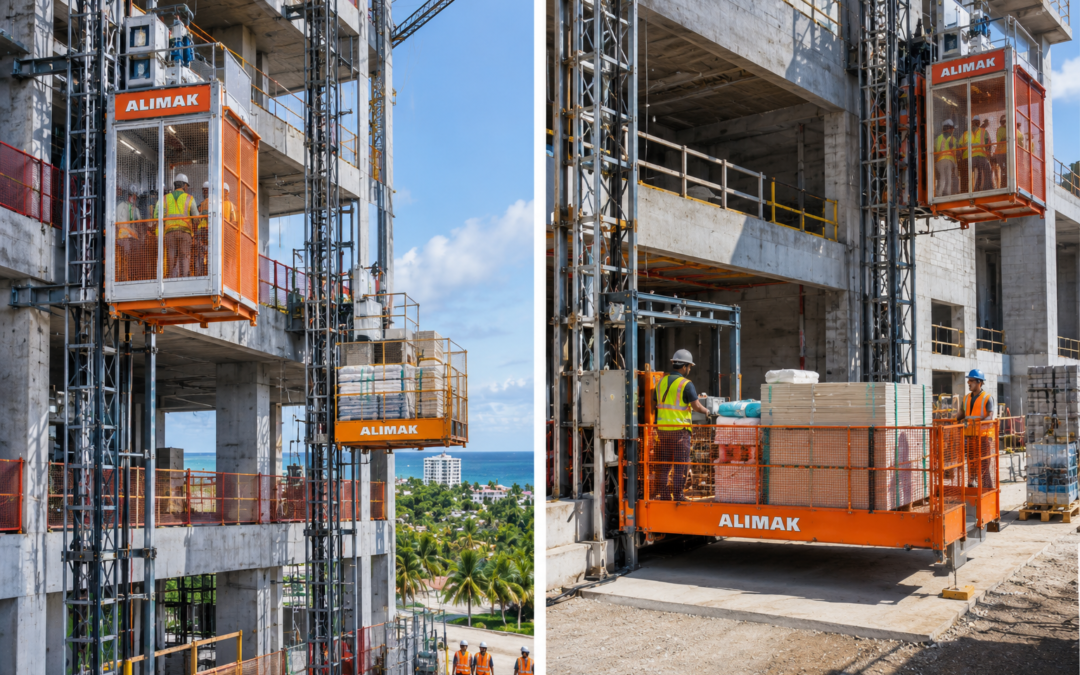
Construction hoisConstruction hoist vs material hoist: a construction hoist, also called a personnel hoist, carries workers and materials in an enclosed car, while a material hoist carries materials only and no one may ride it except for inspection and maintenance. A transport platform sits between the two: it carries materials together with a limited number of trained workers, at a lower speed, and suits low- and mid-rise sites. The right choice depends on who must ride, how high you go and how much traffic the site has.
This guide compares the three machines on riders, speed, loads, safety requirements and standards, and shows which one fits typical projects in Puerto Rico, Jamaica, Trinidad and Tobago and Barbados. All three, in the Alimak range, are rack and pinion machines: a motor-driven pinion climbs a toothed rack on a mast tied to the building. For winch-driven lifts, see winch vs hoist vs industrial elevator.
The short answer
| Construction hoist (personnel hoist) | Material hoist | Transport platform | |
|---|---|---|---|
| Who may ride | Site workers, with materials | No riders (only for inspection and maintenance) | Materials plus a limited number of authorized, trained workers |
| Car | Fully enclosed car with roof and gates | Enclosed car with roof | Open platform with guardrails |
| Speed (Alimak range) | Up to 100 m/min (Scando 650) | Up to 24 m/min (Alimak TPL in material-hoist mode) | Up to 12 m/min when carrying people |
| Typical project | Mid- and high-rise, heavy traffic | Material-only lifting where workers use stairs or another hoist | Low- and mid-rise, renovation, facade work |
| US standard | ANSI/ASSP A10.4 · OSHA 1926.552(c) | ANSI/ASSP A10.5 · OSHA 1926.552(b) | ANSI/SAIA A92.10 |
| European standard | EN 12159 | EN 12158-1 | EN 16719 |
What is a construction hoist?
A construction hoist is a temporary elevator for construction sites that carries workers and materials in an enclosed car running on a mast. It is also called a personnel hoist, passenger hoist or construction elevator.
- Riders: general site personnel. On US sites, a trained operator usually runs the car, according to a hoist expert interviewed by KHL.
- Car and tower: in Puerto Rico, OSHA rule 29 CFR 1926.552 requires personnel hoist cars to be "permanently enclosed on all sides and the top," except at the entrance and exit, and outside hoist towers to be enclosed on the entrance and exit sides for their full height.
- Inspection: a competent person must inspect and test all functions and safety devices after erection, before use, and at intervals of no more than three months, under the same OSHA rule.
- Standards: ANSI/ASSP A10.4 in the US; in Europe, EN 12159, the standard for builders' hoists for persons and materials.
Alimak examples, with the values published by Alimak:
- Alimak Scando 650: 1,500–3,500 kg, 38–100 m/min, car 1.5 m wide and 2.8–5.0 m long. Alimak lists EN 12159 and ANSI A10.4 among its standards.
- Alimak Scando 450: 600–2,000 kg, 30–54 m/min, car 1.4 m wide and 2.0–3.2 m long, single or dual car. Alimak lists EN 12159.
- Alimak LSH: 2,000 kg at 40 m/min, installed inside a lift shaft.
A construction hoist is the only one of the three that moves a large crew quickly to high floors. That is why mid- and high-rise projects use it for the morning peak.
What is a material hoist?
A material hoist is a hoist that lifts materials only. No one may ride it, except for inspection and maintenance.
- Riders: none. In Puerto Rico, OSHA states that "no person shall be allowed to ride on material hoists except for the purposes of inspection and maintenance," and the posted operating rules must include the statement "No Riders Allowed."
- Operating rules: posted at the operator's station, including the signal system and the allowable line speed for various loads.
- Standards: OSHA 1926.552(b)(8) requires material hoists to conform to ANSI A10.5. OSHA cites the 1969 edition; ASSP publishes the current one. In Europe, EN 12158-1 covers builders' hoists for goods with accessible platforms.
Two kinds of material hoist on Caribbean sites:
- Winch-driven material lifts, often called "winch elevators": a platform or bucket raised by rope. They are common for bricks, blocks, mortar and tiles. See our winch vs hoist guide.
- Rack and pinion platforms in material-hoist mode. Alimak transport platforms can also work as material hoists. For its TPL range, Alimak gives up to 24 m/min "when used as a material hoist," compared with up to 12 m/min when carrying personnel.
The limit is clear: if your workers need to ride, a material hoist is the wrong machine. Workers then climb stairs or wait for another hoist.
What is a transport platform?
A transport platform is a rack and pinion platform that carries materials together with authorized, trained workers and their tools, at low speed. It has an open deck with guardrails instead of an enclosed car.
- Riders: authorized and trained personnel only. Under ANSI A92.10, as summarized by a US hoist expert in KHL, people may use no more than 50% of the platform's rated payload. Alimak states that its TPL platforms can carry "up to seven people depending on the limitations of local regulations."
- Speed: limited to 12 m/min (40 ft/min) when carrying people, according to the same KHL source and Alimak.
- Base protection: instead of a full-height base enclosure, the US standard requires the platform to stop automatically about 3 m (10 ft) above ground and sound an alarm for the final descent.
- Standards: ANSI/SAIA A92.10 in the US; EN 16719 in Europe. EN 16719 covers platforms with an open carrier and hold-to-run controls, and excludes goods-only hoists, covered by EN 12158-1, and passenger hoists, covered by EN 12159.
Alimak example, with the values published by Alimak:
- Alimak TPM transport platforms: 1,300–4,000 kg in six configurations, 12/24 m/min, decks from 1.6 × 1.6 m up to 3.2 × 3.2 m or 1.6 × 4.8 m, lifting height up to 200 m, usable as a transport platform or a material hoist, inside or outside the building, per the Alimak TPM product page.
A transport platform is strong on bulky loads such as pallets, glazing and prefabricated elements, and on low-traffic sites. It is slow for moving a large crew to high floors.
Is a mast climbing work platform a transport platform?
No. A mast climbing work platform, or MCWP, is a work platform: crews work from it on the facade as it climbs. A transport platform moves people and materials between landings. Some projects use both: the MCWP for facade work and a transport platform or construction hoist for access and materials.
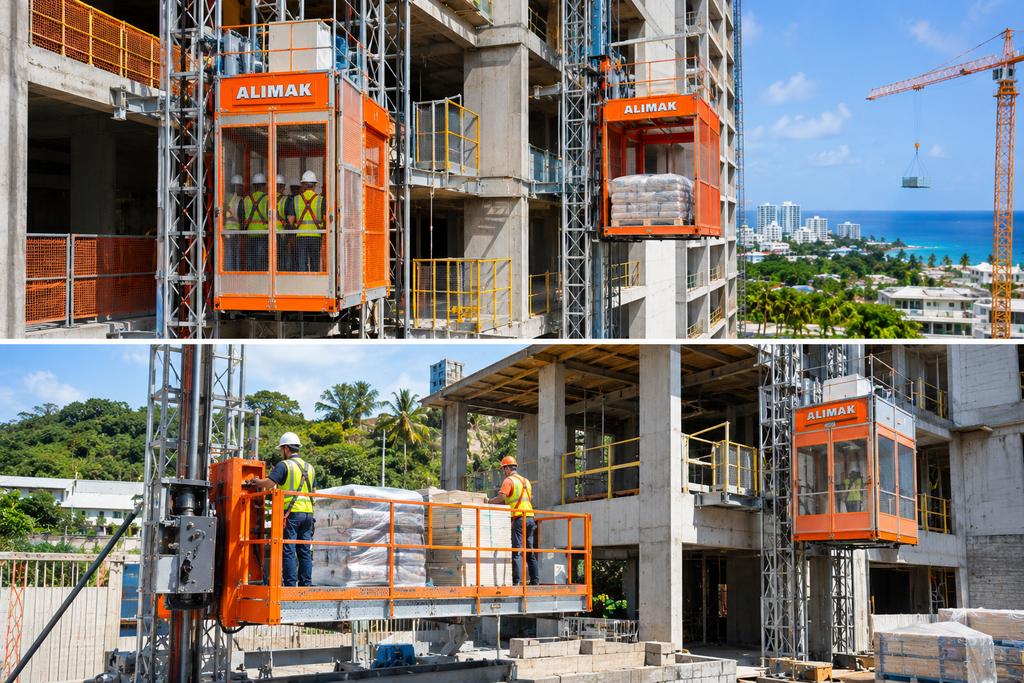
Construction hoist vs material hoist vs transport platform: key differences
1. Who may ride. This is the first filter. Crew transport needs a construction hoist or, for small trained crews, a transport platform. A material hoist carries no one.
2. Speed and height. At 12 m/min, a transport platform needs about 5 minutes to climb 60 m, before any stops. A construction hoist at 54 m/min climbs the same height in just over 1 minute, and at 100 m/min in about 36 seconds. On taller buildings the gap decides how many workers reach their floors in the morning peak; see how many construction hoists a high-rise needs.
3. Loads and load shape. Payloads overlap: TPM platforms carry up to 4,000 kg and the Scando 650 up to 3,500 kg. The difference is the shape. An open TPM deck takes wide or bulky loads; a construction hoist car is narrower, 1.4–1.5 m wide on the Scando range, but can be up to 5.0 m long on the Scando 650.
4. Enclosure and base. Under US standards, construction hoists and material hoists need enclosed cars with a roof and a full-height base enclosure; transport platforms use guardrails and an automatic stop above ground. This makes the platform simpler to set up on small sites.
5. Operation. A construction hoist on a busy site usually has a dedicated operator. On a transport platform, the trained workers riding it often run it themselves.
6. Cost. Bridge360 quotes each project separately; prices depend on the model, height, rental period and installation. A transport platform is usually the simpler machine, but the right comparison is cost per worker or per load moved, not the rental price alone.
Which one fits your project?
| Situation | Best fit |
|---|---|
| Mid- or high-rise building; crews of more than a few workers must reach upper floors every morning | Construction hoist (single or dual car) |
| High-rise fit-out, where crews and materials compete all day | Dual-car construction hoist, or a construction hoist plus a separate material solution |
| Low-rise or mid-rise building, small trained crews, bulky loads | Transport platform |
| Facade renovation or refurbishment with scaffolding or MCWP | Transport platform |
| Only materials move; workers use stairs or another hoist | Material hoist (or a transport platform in material-hoist mode) |
| Work inside the building after the facade closes | In-shaft construction hoist (Alimak LSH) |
On large sites, separate machines for people and materials keep the crew hoist free during peaks. Plan the combination with the construction hoist planning checklist.
Common mistakes
- Letting workers ride a material hoist. It is prohibited in Puerto Rico under OSHA 1926.552(b) and unsafe anywhere: a material hoist is not built or certified to carry people.
- Using a transport platform as the crew hoist on a tall building. At 12 m/min, queues grow fast as floors are added.
- Exceeding the people limit on a transport platform. The number of persons is on the data plate and in the local rules, not a guess.
- Choosing by payload alone. Speed, riders and load shape matter as much as kilograms.
- Forgetting the phase change. Many projects start with a transport platform and need a construction hoist when fit-out begins, or the reverse. Plan the switch and the rental periods together.
What changes in the Caribbean?
- Which rules apply. US OSHA rules apply in Puerto Rico. Trinidad and Tobago has its Occupational Safety and Health Act, 2004, Barbados its Safety and Health at Work Act, 2005, and Jamaica its own occupational safety laws. Project specifications in these markets often reference EN or ANSI standards; check the contract and the local authority before you choose.
- Hurricane season. The Atlantic season runs from June 1 to November 30, according to the NHC. All three machines are mast-mounted and need a storm plan based on the manufacturer's instructions. See hurricane preparedness for construction sites.
- Hotel and resort projects. Low-rise resort blocks often suit transport platforms, while tower hotels need construction hoists for the fit-out peak. See logistics for hotel and resort construction.
- Rent or buy. Most of these machines are needed for one project phase. Compare both options in construction hoist rental vs purchase.
Frequently asked questions
What is the difference between a construction hoist and a material hoist? A construction hoist carries workers and materials in an enclosed car. A material hoist carries materials only; no one may ride it except for inspection and maintenance.
Can a material hoist carry people? No. In Puerto Rico, OSHA 1926.552(b) prohibits riders on material hoists except for inspection and maintenance and requires a "No Riders Allowed" notice. If people need to ride, use a construction hoist or a transport platform.
What is the difference between a transport platform and a construction hoist? A transport platform has an open deck, runs at 12 m/min when carrying people and takes a limited number of trained workers with materials. A construction hoist has an enclosed car, runs much faster and carries general site personnel.
How many people can ride a transport platform? It depends on the model, its rated payload and local rules. Alimak states that its TPL platforms can carry up to seven people, subject to local regulations. Check the data plate.
Can one machine work as both a transport platform and a material hoist? Yes. Alimak lists dual use as a transport platform or a material hoist for its TPM range. For the TPL range, Alimak gives up to 12 m/min when carrying personnel and up to 24 m/min as a material hoist.
Which is cheaper? A transport platform is usually the simpler machine, but compare the cost per worker or load moved over the project phase. Bridge360 quotes each project.
Not sure which one your site needs?
Bridge360 helps contractors in Jamaica, Trinidad and Tobago, Barbados and Puerto Rico choose between Alimak construction hoists, transport platforms and material solutions, based on height, crew size, loads and schedule. With over 13 years of experience with Alimak equipment in the Caribbean, certified operators and 24/7 support, Bridge360 also offers construction hoist rental for each phase of your project.