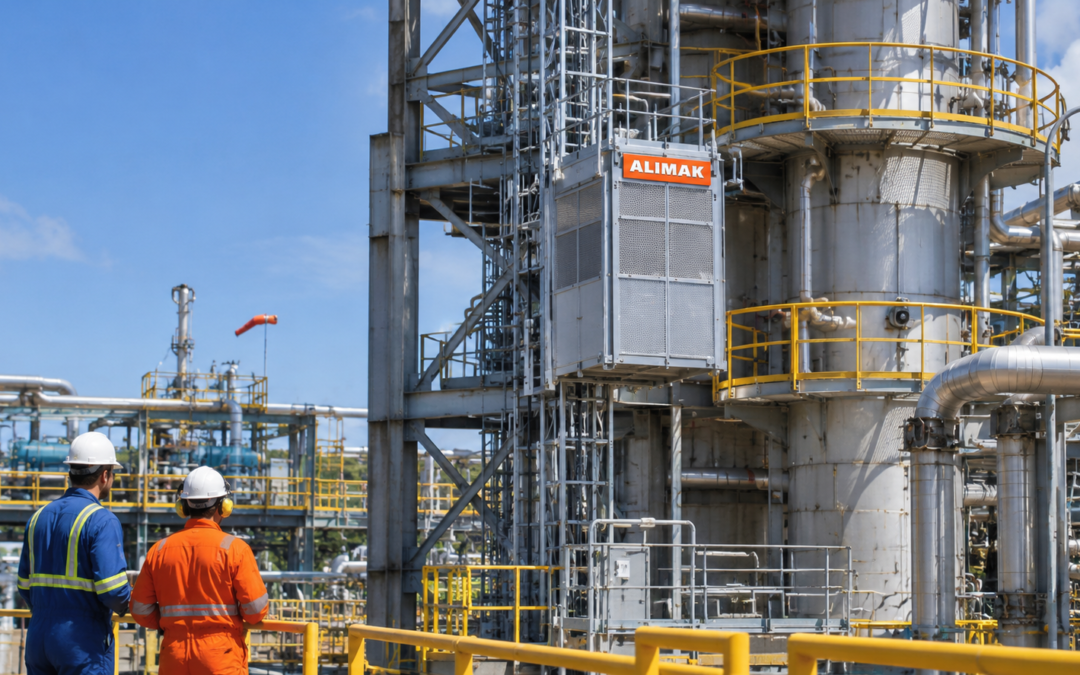
An explosion-proof elevator is an elevator built and certified so that none of its electrical or mechanical parts can ignite a flammable gas, vapour or dust in the area where it runs. Refineries, petrochemical plants, LNG facilities and offshore platforms need one wherever the hazardous area classification says an explosive atmosphere may occur. Choosing the right one starts with that classification: the zone (or division), the gas group and the temperature class, followed by the certification scheme your jurisdiction accepts: ATEX, IECEx or the US National Electrical Code (NEC).
This guide explains those terms in plain language, shows what to put in a specification, and uses the Alimak SE-Ex as a worked example.
What makes an elevator "explosion-proof"?
A standard elevator has motors, brakes, contactors, limit switches and lights that can produce sparks or hot surfaces. In a hazardous area, any of them can become an ignition source. An explosion-proof (Ex) elevator uses equipment designed and certified to prevent ignition, for example flameproof enclosures, increased-safety components or intrinsically safe circuits, as defined in the IEC 60079 series.
Electrical parts are not the only risk. In the EU, ATEX Directive 2014/34/EU covers equipment and protective systems for potentially explosive atmospheres, including non-electrical equipment. Alimak states that the SE-Ex is "fully compliant with ATEX and EN-13463", the standard for non-electrical equipment, with tests witnessed by a third party (Alimak SE-Ex brochure).
Hazardous area zones: where can the elevator run?
The facility owner classifies the plant into zones according to how often an explosive atmosphere is present. In the EU, the zones are defined in Annex I of Directive 1999/92/EC:
| Zone (gas / dust) | Explosive atmosphere is… | Equipment category allowed (ATEX) |
|---|---|---|
| Zone 0 / Zone 20 | Present continuously, for long periods or frequently | Category 1 |
| Zone 1 / Zone 21 | Likely to occur occasionally in normal operation | Category 1 or 2 |
| Zone 2 / Zone 22 | Not likely in normal operation; if it occurs, only for a short time | Category 1, 2 or 3 |
Elevators in process areas usually serve Zone 1 or Zone 2 locations: towers, columns, tank roofs, flare stacks or process structures. Zone 0 is typically inside vessels and tanks, where people do not ride elevators.
NEC Class and Division: the North American system
In the US, and in Puerto Rico, hazardous locations follow the NEC Class/Division system (a Zone system also exists). OSHA uses the same definitions (29 CFR 1910.399):
- Class I: flammable gases or vapours. Class II: combustible dust.
- Division 1: ignitable concentrations may exist under normal operating conditions.
- Division 2: flammable materials are handled or used, but ignitable concentrations are normally confined or prevented and occur only under abnormal conditions.
Roughly, Division 1 corresponds to Zones 0 and 1, and Division 2 to Zone 2. The exact equivalence must be checked against the codes in force.
Gas groups and temperature classes
Two more ratings decide whether a certified elevator suits your atmosphere. Gases and vapours are classified by both in IEC 60079-20-1, and each substance's group and auto-ignition temperature appear in its safety data:
- Gas group (ATEX/IEC: IIA, IIB, IIC; NEC: A, B, C, D) ranks gases by how easily they ignite. IIC (NEC A and B) is the most demanding group and includes hydrogen and acetylene. IIA covers gases such as propane. Equipment certified for a higher group also covers the lower ones.
- Temperature class (T1 to T6) is the maximum surface temperature the equipment may reach: T1 up to 450 °C, T2 300 °C, T3 200 °C, T4 135 °C, T5 100 °C, T6 85 °C. It must be below the auto-ignition temperature of the gases present.
Why this matters in refineries: units that handle hydrogen (hydrotreaters, hydrocrackers, reformers) may be classified IIC. An elevator certified only up to IIB is not suitable there, even if the zone rating matches.
ATEX vs IECEx vs NEC: which certification do you need?
| Scheme | What it is | Where it is required or accepted |
|---|---|---|
| ATEX | EU directives: 2014/34/EU for equipment, 1999/92/EC for workplaces | Mandatory in the EU; widely specified by multinational operators elsewhere |
| IECEx | International certification system for equipment and services based on IEC 60079 standards | Accepted in many countries; often requested on international projects |
| NEC / UL / CSA | North American codes and listing (Class/Division or Zone) | US (including Puerto Rico) and Canada |
In the English-speaking Caribbean, the requirement usually comes from the operator's corporate standards, the project specification and the national regulator. Confirm the accepted scheme before you request quotes. A certificate for one scheme does not automatically satisfy another.
Worked example: what the Alimak SE-Ex is certified for
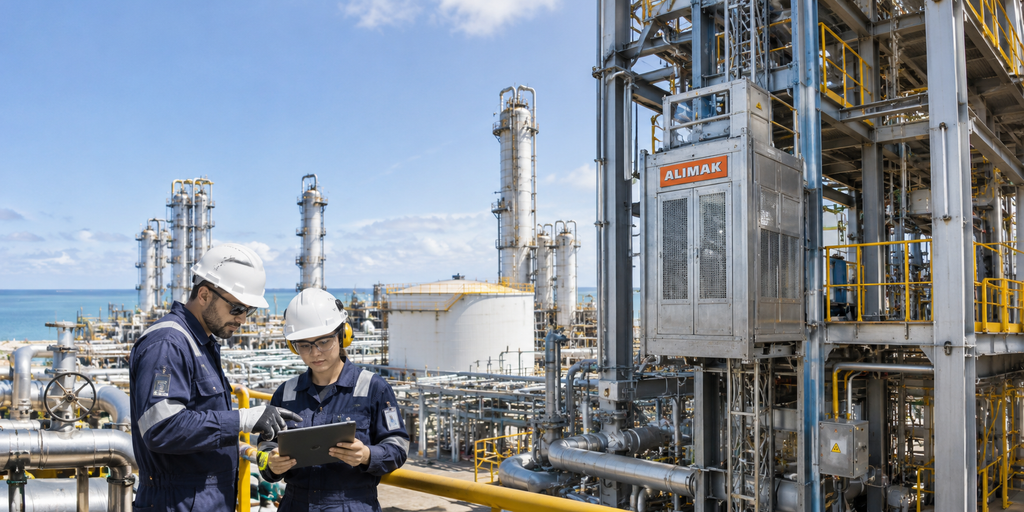
The Alimak SE-Ex is the explosion-protected version of the Alimak SE rack and pinion industrial elevator. The ratings below come from the Alimak SE-Ex brochure (1292, January 2022). Ratings can change between product generations, so confirm the certificate for your specific unit with Alimak.
| Rating | ATEX | NEC |
|---|---|---|
| Area | Zone 1* or Zone 2 | Class I, Division 2 |
| Gas group | I, IIA or IIB | C or D |
| Temperature class | T1–T3 (T4) | T1–T3 (T4) |
| Dust | — | Class II, Division 2, groups F or G |
*Zone 1 up to 1,600 kg payload capacity.
Other data from the same brochure:
- Payload: 450–2,800 kg in the standard range, depending on car size and drive (Zone 1 up to 1,600 kg). alimak.com currently lists 450–1,600 kg for the SE-Ex.
- Speed: 0.5–0.7 m/s with frequency control; 0.32–0.6 m/s direct-on-line.
- Lifting height: up to 80 m standard; more on request.
- Construction: drive on top of the car, no machine room or shaft; car of saltwater-proof anodized aluminum and hot-dip galvanized steel; stainless steel electrical cabinets; stainless steel cars available for aggressive environments.
- Safety and options: overspeed safety device; centrifugal brake that lowers passengers to the landing below in a power failure; overload sensing; fire and gas alarm option; A3 remote monitoring; two elevators can run on one mast.
What this means for a specification: the SE-Ex suits Zone 1 and Zone 2 gas areas with IIA/IIB gases and T3/T4 requirements, and NEC Division 2 locations. For IIC gases, Zone 0, NEC Division 1 or ATEX dust zones, the brochure does not list a rating, so confirm with Alimak before specifying.
What to include in an explosion-proof elevator specification
- Hazardous area classification drawing for the elevator's full travel and every landing: zone or division, and boundaries.
- Gas group and temperature class of the substances present (and dust group if relevant).
- Certification scheme required: ATEX, IECEx and/or NEC, plus any operator standard.
- Payload, car size, travel height and landings, including the heaviest recurring item.
- Environment: offshore, salt spray, corrosive vapours, temperature range.
- Integration: fire and gas alarm interface, emergency lowering, communication.
- Inspection and maintenance plan by technicians competent in Ex equipment. The IECEx system also certifies service facilities for Ex installation, inspection and repair under IEC 60079-14, -17 and -19.
Where explosion-proof elevators are used
Alimak markets its Ex elevators for natural gas processing plants, oil and petroleum refineries, LNG storage tanks and petrochemical plants (Alimak – Oil & Gas). Typical applications:
- distillation columns, reactors and process towers
- LNG and crude storage tank access
- flare stacks and stacks
- offshore platform modules
- chemical and fertilizer plants
In Trinidad and Tobago, petrochemical, LNG and refining assets make explosion protection a common requirement. See industrial elevators for oil and gas facilities in Trinidad & Tobago. In Puerto Rico, power plants and fuel terminals follow US NEC and OSHA rules.
How is an explosion-proof elevator maintained?
Ex equipment keeps its protection only if it is inspected and repaired correctly. A cover bolt left loose on a flameproof enclosure, or a non-certified replacement part, can invalidate the protection. The maintenance plan should include:
- periodic Ex inspections by competent personnel (IEC 60079-17 is the reference standard)
- genuine, certified replacement parts
- records of every inspection and repair, kept with the elevator's certification documents
- inspection after events such as storms, fires or impact damage
Bridge360 provides Alimak maintenance services with certified technicians and 24/7 support. Confirm Ex-specific competence for each hazardous-area installation.
Frequently asked questions
What is the difference between ATEX and IECEx? ATEX is the EU's legal framework for equipment and workplaces in explosive atmospheres. IECEx is an international certification system based on IEC 60079 standards. They are similar technically, but a certificate under one does not replace the other where a specific scheme is required.
Can an explosion-proof elevator be used in Zone 0? Zone 0 requires Category 1 equipment. Elevators are normally installed in Zone 1 or Zone 2 areas. The Alimak SE-Ex is rated for Zone 1 or 2 (ATEX) and Class I, Division 2 (NEC).
Does an explosion-proof elevator need a machine room? Not with rack and pinion designs such as the Alimak SE-Ex: the drive sits on top of the car and no machine room or shaft is required.
Which gas groups does the Alimak SE-Ex cover? Group I, IIA and IIB under ATEX, and groups C and D under NEC, according to the Alimak brochure. For IIC (hydrogen, acetylene), confirm with Alimak.
Who decides the hazardous zone? The facility owner or operator, through a hazardous area classification by competent engineers. The elevator supplier selects certified equipment to match it.
Specify the right explosion-proof elevator
Bridge360 supplies and maintains Alimak industrial elevators, including the Alimak SE-Ex, for refineries, petrochemical plants and energy facilities in Trinidad and Tobago, Puerto Rico, Jamaica and Barbados. Share your hazardous area classification and we will check it against the elevator's certification with Alimak.