
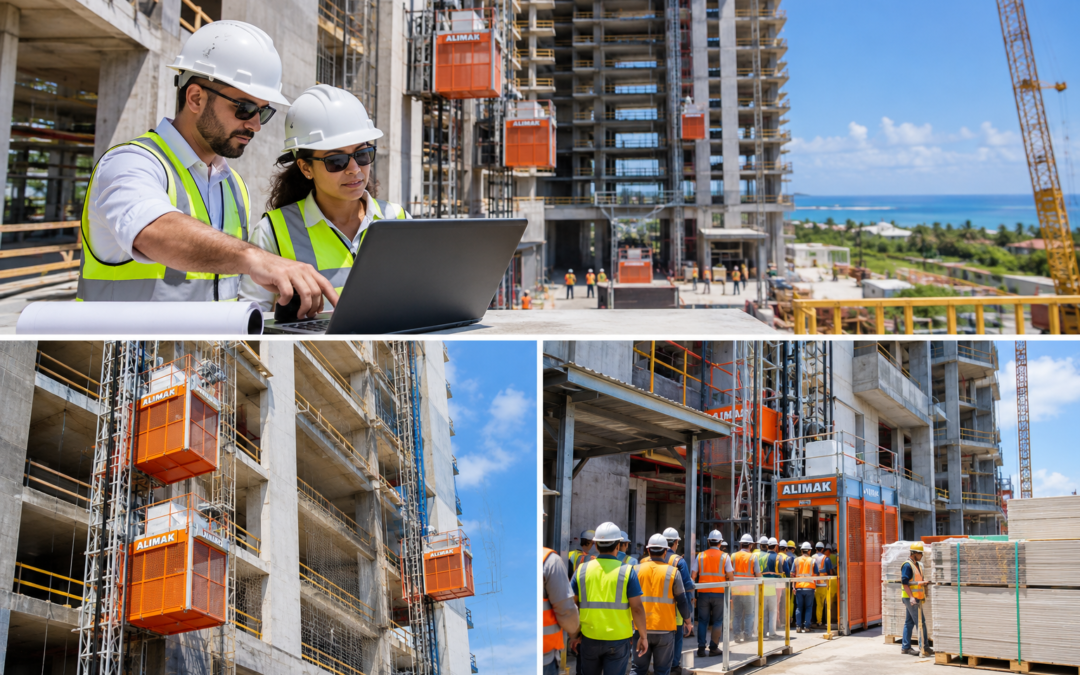
How many construction hoists a high-rise project needs depends on how many people and how much material must move during the busiest part of the day, not on the number of floors alone. The answer comes from a simple calculation: how long one round trip takes, how many people each car carries per trip, and how many workers must reach their floors within your target time. This guide shows the method, when a dual-car hoist is enough, and when you need a second hoist.
It builds on our construction hoist planning checklist, which lists everything to define before installation, and adds the numbers.
Short answer
- Low- and mid-rise buildings with a moderate workforce can often work with one single-car hoist, especially if the tower crane still handles materials.
- High-rise towers usually need more than one car once crews and fit-out materials compete for the hoist. Dual cars on one mast are the first step; a second mast (or more) follows when one dual hoist still cannot clear the morning peak.
- Large towers use several cars. The Strata Tower in London (147 m, 43 storeys) moved about 400 workers at peak with two twin-cage high-speed Alimak passenger hoists plus a 4,000 kg transport hoist (KHL). One Sydney Harbour, with towers of 238 m and 259 m lifting height, used Alimak Scando 650 hoists on two common towers, eight to nine cars in total (Alimak case).
The calculation below tells you where your project sits.
Step 1: define the peak you must clear
The morning arrival is usually the critical peak: most workers need to go up within a short window. Lunch and the end of the shift follow. Define three numbers:
- Peak crew (P): how many workers must go up in the morning peak. Count by trade and by floor; not everyone starts at the same time.
- Target window (T): how many minutes you accept for getting that crew to their floors (for example 30 minutes). This is a project decision: every minute workers wait is paid time without work.
- Floors served: which landings will be in use during the peak.
Material deliveries are a second, separate demand. Plan them outside the crew peaks or give them a dedicated car (Step 5).
Step 2: estimate one round trip
The round-trip time (RTT) is how long one car takes to load at the ground, travel up, stop at the landings people need, and come back down. Elevator traffic engineering uses the same concept of round-trip time and handling capacity (CIBSE Guide D for permanent lifts).
RTT = travel time up and down + loading time at the ground + time at each stop
- Travel time = 2 × travel height ÷ speed. Alimak construction hoists range from 30–54 m/min (Scando 450) to 38–100 m/min (Scando 650), per Alimak.
- Loading time at the ground: workers boarding, doors closing.
- Time per stop: decelerating, opening, unloading and closing at each landing. With many stops, this often outweighs travel time.
Measure loading and stop times on a similar site if you can; they depend on your crews, gates and operator.
Step 3: calculate how many workers one car moves
- Trips per hour = 3,600 ÷ RTT (in seconds)
- Workers per hour per car = trips per hour × workers per trip
For workers per trip, use the car's rated number of persons (on the data plate and in the manufacturer's data) and a realistic loading, because not every trip leaves full.
Step 4: work out the number of cars
Cars needed = peak crew ÷ workers one car moves within the target window
Round up. Then decide how to provide those cars: a dual-car hoist puts two cars on one mast; more cars need another mast.
Worked example (illustrative inputs)
The values below are assumptions to show the method. Replace them with your own project data and the rated values of the hoist you are considering.
- Building: 30 floors at 3.2 m = 96 m travel height
- Peak crew: 300 workers in a 30-minute window
- Car: rated for 30 persons, loaded at 80% on average = 24 workers per trip
- Loading at the ground: 60 s; 6 stops per trip at 30 s each = 180 s
| Hoist at 66 m/min | Hoist at 100 m/min | |
|---|---|---|
| Travel time (up + down) | 175 s | 115 s |
| Round-trip time | 415 s (6.9 min) | 355 s (5.9 min) |
| Trips per hour | 8.7 | 10.1 |
| Workers per hour per car | ≈ 208 | ≈ 243 |
| Workers per car in 30 min | ≈ 104 | ≈ 122 |
| Cars needed for 300 workers | 3 (2.9) | 3 (2.5) |
What the example shows:
- More speed alone did not change the answer. Stops and loading take most of the round trip, so a faster hoist saved about one minute per trip but still needed three cars.
- Fewer stops per trip help as much as speed. Grouping crews by floor, or assigning cars to zones (low floors / high floors), shortens each trip.
- Spreading the peak can save a car. If trades start in two groups 30 minutes apart (150 + 150), two cars clear each group in time.
Step 5: add material demand
Fit-out materials need their own count: pallets of drywall, tiles, fixtures, glazing and waste going down. Estimate trips per day (loads ÷ loads per trip) and decide:
- Schedule materials between crew peaks on the same cars, if the daily total fits; or
- Dedicate one car to materials during fit-out, often in a dual-car hoist (one car for people, one for materials); or
- Add a transport platform for bulky loads on low- and mid-rise sections. Alimak transport platforms (TPM) carry 1,300–4,000 kg at 12/24 m/min.
Check that the largest recurring item fits the car. The Alimak Scando 650 car is 1.5 m wide and can be extended up to 5.0 m long.
Single car vs dual car: which one?
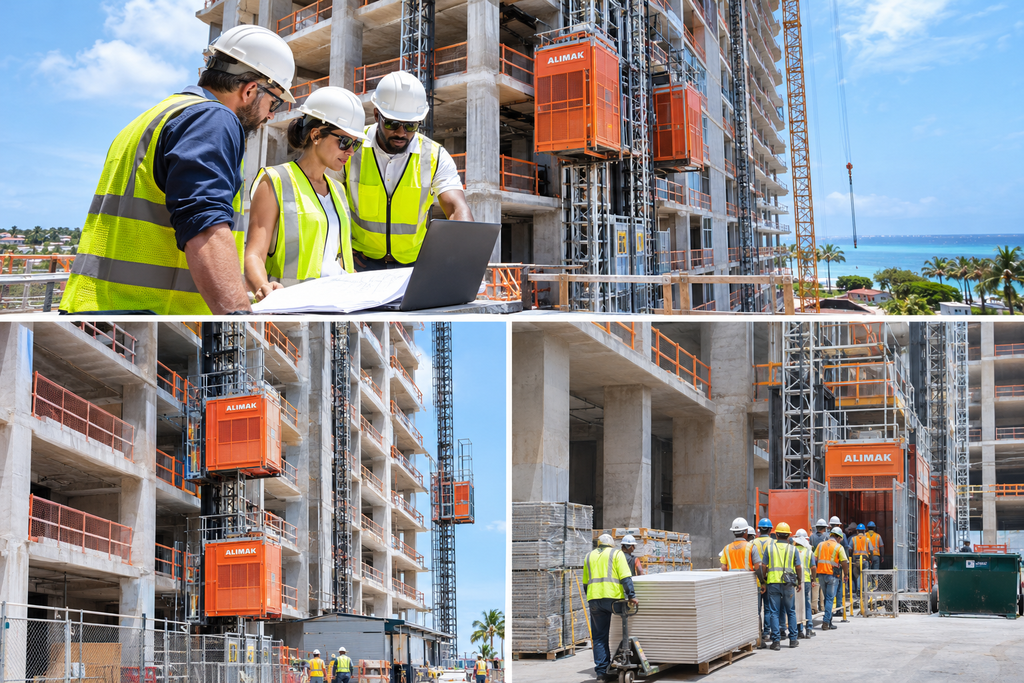
A dual-car hoist runs two independent cars on one mast. It doubles the cars without adding a second mast and a second base.
| Situation | Single car | Dual car |
|---|---|---|
| Peak crew | Moderate; one car clears it in the target window | One car cannot clear it, two can |
| Crews vs materials | Materials can be scheduled outside the peaks | Crews and materials compete all day |
| Redundancy | One breakdown stops all vertical transport | If one car has a fault, the other can keep working |
| Building face and base | Smallest footprint | Wider base enclosure on the same mast |
| Typical project | Low- and mid-rise, smaller crews | Mid- and high-rise, hotels, residential towers |
Both the Alimak Scando 450 and the Scando 650 are available in single- and dual-car configurations. The Scando 650 control system (ALC-II) can group-control up to six cars: it stores landing calls and sends the nearest car, which reduces waiting at large sites (Alimak Scando 650 brochure).
When do you need a second hoist (another mast)?
Add another hoist when:
- the calculation needs more cars than one dual hoist provides
- the building has separate towers or wings that one mast cannot serve efficiently
- one mast would have to serve too many landings, making round trips long; splitting floors between hoists shortens each trip
- you need redundancy: on a critical schedule, one hoist being down should not stop the site
- the facade sequence requires one hoist to be removed early (for example, to close the envelope), and an in-shaft hoist such as the Alimak LSH takes over inside the building
How the number changes during the project
Hoist demand is not constant:
- Structure phase: smaller crews; the tower crane does most lifting.
- Fit-out and MEP: the peak. Most trades work at the same time and finishing materials move every day. This is usually when a second car or hoist pays for itself.
- Close-out: demand falls; exterior hoists are removed as the facade closes, sometimes replaced by an in-shaft hoist or the building's permanent elevators.
Plan the number of cars for the fit-out peak, and the rental period of each hoist for the phase in which it is needed. Renting lets you add a car or a second hoist only for the months it is needed; see construction hoist rental.
What about Caribbean projects?
- Hurricane season: one hoist out of service after a storm stops the site if there is no second car. Redundancy has extra value from June to November.
- Service distance: if technicians and spare parts are far away, a breakdown lasts longer; a second car or nearby support reduces the risk.
- Hotel and resort schedules: fixed opening dates make fit-out peaks steeper. See logistics for hotel and resort construction.
Typical configurations to start the conversation
| Project type | Starting point to verify with the calculation |
|---|---|
| Low-rise, small crew | 1 single-car hoist, or a transport platform for materials |
| Mid-rise residential or hotel | 1 dual-car hoist (Alimak Scando 450 or Scando 650) |
| High-rise tower | 1–2 dual-car high-speed hoists (Scando 650), plus a material solution for fit-out |
| Multi-tower or very tall projects | Several hoists, possibly on common towers, with group control |
These are starting points, not rules; the calculation for your crew, height and schedule decides.
Frequently asked questions
How many construction hoists does a 30-story building need? It depends on the peak crew, the target window and the stops per trip. In our illustrative example, 300 workers in 30 minutes needed three cars; with staggered start times, two were enough. Run the calculation with your own data.
Is a faster hoist better than a second car? Not always. Speed shortens travel, but when stops and loading take most of the round trip, an extra car adds more capacity. Some projects need both.
What is a dual-car construction hoist? A hoist with two independent cars running on the same mast. It doubles the number of cars without a second mast, and if one car has a fault, the other can keep working.
Can one car carry people and the other materials? Yes. That is a common way to use a dual-car hoist during fit-out, so crews and materials stop competing for the same car.
When should the number of hoists be decided? In pre-construction, together with the tower crane strategy, site layout and facade sequence, because hoist positions and tie-ins affect the building design and schedule.
Get a hoist calculation for your project
Bridge360 helps contractors in Jamaica, Trinidad and Tobago, Barbados and Puerto Rico size their vertical logistics: number of cars, configuration, speed and placement. With over 13 years of experience with Alimak equipment in the Caribbean, certified technicians and 24/7 support, Bridge360 supplies Alimak construction hoists for rental and purchase.