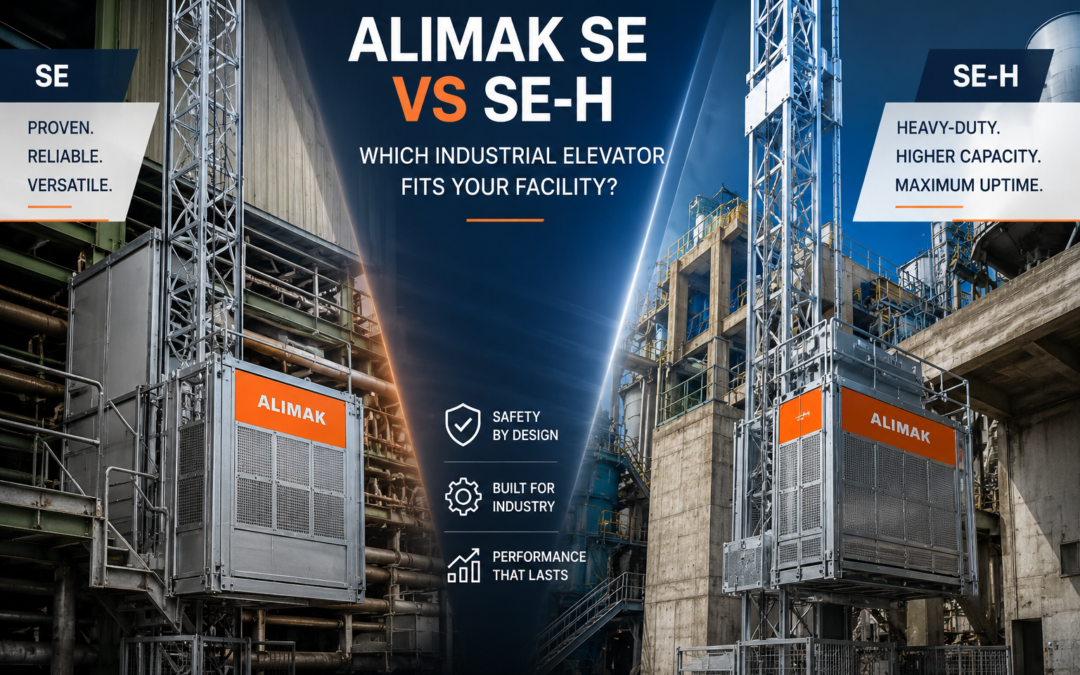
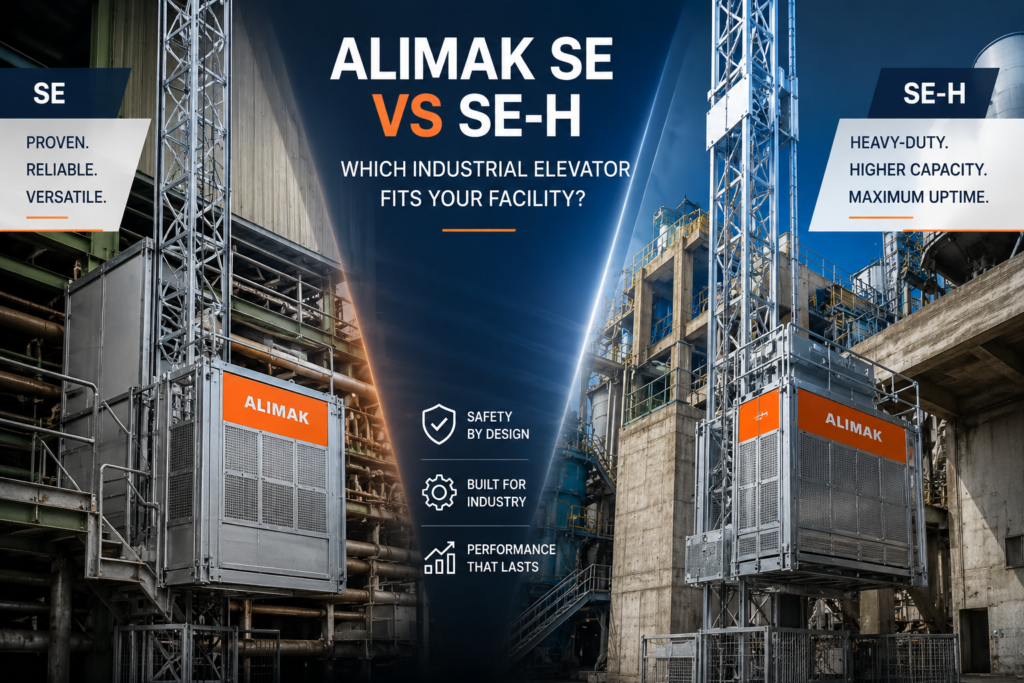
Choosing between Alimak SE and Alimak SE-H depends on payload, car size, travel height, operating environment, material movement and maintenance requirements. The Alimak SE is typically a strong fit for standard industrial passenger and freight access, while the Alimak SE-H is better suited for heavier loads, larger components and demanding industrial transport needs.
For Caribbean facilities, the decision is not only about elevator capacity. Salt air, heat, humidity, dust, vibration, operating frequency, spare parts planning and regional maintenance support should all influence the final specification.
Bridge360 provides Alimak industrial elevator solutions for mines, cement plants, ports, power plants, manufacturing facilities, oil and gas operations and heavy industrial environments across the Caribbean.
If your team is comparing models for a specific facility, this guide will help you understand when to consider Alimak SE and when to move toward Alimak SE-H.
Quick answer
Choose Alimak SE when your facility needs modular industrial access for personnel, tools and standard material loads. Choose Alimak SE-H when your project requires higher payload capacity, larger car sizes, heavier components or more demanding freight movement. The final decision should be based on payload, environment, duty cycle, travel height and maintenance strategy.
Alimak SE vs SE-H comparison
| Comparison point | Alimak SE | Alimak SE-H |
|---|---|---|
| Best fit | Standard industrial passenger and freight access | Higher-capacity industrial passenger and freight access |
| Capacity range | 300–2,000 kg | 2,100–3,300 kg |
| Main use case | Personnel, tools and moderate material loads | Heavier tools, larger components and demanding freight movement |
| Typical applications | Silos, conveyors, platforms, industrial buildings and maintenance routes | Mining operations, cement plants, processing structures, smelters and heavy industrial facilities |
| Ideal buyer concern | Reliable daily access | Heavy-load movement and larger transport requirements |
| When to consider it | When access is the main problem | When payload and component size are the main problems |
Who should use this comparison?
This guide is for plant managers, maintenance leaders, HSE teams, project engineers, procurement teams and facility owners evaluating permanent industrial elevators for demanding environments.
It is especially useful if your facility operates in:
- Mining and materials handling.
- Cement production.
- Ports and logistics.
- Power generation.
- Oil and gas support infrastructure.
- Manufacturing.
- Food and beverage production.
- Large infrastructure sites.
- Caribbean coastal or outdoor industrial environments.
Why this decision matters
The wrong industrial elevator specification can create long-term access problems.
If the elevator is undersized, maintenance teams may struggle to move tools, spare parts or components efficiently. If the elevator is over-specified, the facility may invest in a heavier configuration than it actually needs.
The goal is not to choose the largest elevator. The goal is to choose the right elevator for the facility’s operating reality.
A good model selection should consider:
- Required payload.
- Number of passengers.
- Size of tools and spare parts.
- Travel height.
- Number of landings.
- Indoor or outdoor exposure.
- Dust, humidity, salt air or vibration.
- Operating frequency.
- Safety and inspection needs.
- Maintenance access.
- Long-term spare parts support.
For Caribbean facilities, the environment can be just as important as the payload.
Alimak SE: what it is best for
The Alimak SE is a modular rack-and-pinion industrial elevator designed for passenger and freight movement in demanding industrial environments.
It is a strong fit when a facility needs reliable daily access for personnel, tools and standard material movement across elevated structures.
According to Alimak’s official SE product page, the Alimak SE range is designed for passenger and freight transport across a broad range of industrial applications, with capacity options listed from 300 kg to 2,000 kg.
For Caribbean facilities, the Alimak SE can support access to:
- Silos.
- Conveyors.
- Process towers.
- Inspection platforms.
- Industrial buildings.
- Cement plant structures.
- Manufacturing facilities.
- Power plant areas.
- Port and logistics infrastructure.
The Alimak SE is usually the better direction when the facility needs a reliable industrial elevator, but does not require the heavier payload range or larger transport format of the SE-H.
When Alimak SE makes sense
Alimak SE makes sense when the main requirement is dependable access for personnel, tools and lighter freight.
It should be considered when:
- The facility needs regular maintenance access.
- Teams need to reduce ladder or stair climbing.
- Personnel and tools need to move between levels.
- Payload requirements fit within the standard SE range.
- The structure requires a compact industrial elevator solution.
- The elevator will support inspection and maintenance routes.
- The facility needs indoor or outdoor rack-and-pinion access.
- The project does not require heavy equipment or forklift-style loading.
For many industrial sites, Alimak SE is the practical workhorse.
Best-fit summary for Alimak SE
Alimak SE is a strong fit for facilities that need reliable industrial passenger and material access without requiring heavy-load transport. It is especially useful for maintenance routes, silos, conveyors, towers, platforms and plant structures where teams need safe daily movement between levels.
Alimak SE-H: what it is best for
The Alimak SE-H is a higher-capacity rack-and-pinion industrial elevator designed for heavier industrial transport requirements.
It is a better fit when a facility needs to move larger tools, heavy replacement parts, equipment, multiple personnel or bulky freight between levels.
According to Alimak’s official SE-H product page, the Alimak SE-H range is built for passengers and freight in demanding environments, with capacity options listed from 2,100 kg to 3,300 kg and flexible car size configurations.
For Caribbean facilities, the Alimak SE-H can support heavier access needs in:
- Mining operations.
- Cement plants.
- Smelters.
- Heavy manufacturing facilities.
- Large infrastructure projects.
- Processing plants.
- Power generation facilities.
- Industrial sites with larger replacement parts.
The SE-H should be considered when standard personnel and tool access is not enough.
When Alimak SE-H makes sense
Alimak SE-H makes sense when the facility needs more payload capacity, larger car dimensions or stronger freight capability.
It should be considered when:
- Heavy tools or replacement parts need vertical movement.
- Maintenance teams move bulky components between levels.
- Several workers may travel with equipment.
- The facility has large elevated process structures.
- The site requires a more heavy-duty elevator configuration.
- The access route supports high-value production equipment.
- Downtime from slow material movement is costly.
- The operation needs a more robust long-term transport solution.
For heavy industrial sites, the SE-H can reduce the operational friction of moving people and equipment separately.
Best-fit summary for Alimak SE-H
Alimak SE-H is a strong fit when payload is the deciding factor. It is designed for facilities that need to move heavier tools, larger components, multiple workers or industrial freight across demanding structures where standard access is not enough.
Facility need comparison
| Facility need | Better direction | Why |
|---|---|---|
| Daily maintenance access | Alimak SE | Supports personnel, tools and standard material movement |
| Moving heavy replacement parts | Alimak SE-H | Provides higher payload capacity for larger components |
| Access to silos or conveyors | Alimak SE | Works well when payload requirements are moderate |
| Cement plant preheater towers | Alimak SE-H | Often requires heavier-duty transport for maintenance teams and parts |
| Mining processing structures | Alimak SE-H | Better suited for dust, heavy loads and demanding industrial movement |
| General industrial inspection routes | Alimak SE | Practical for recurring access without heavy freight needs |
| High-value shutdown maintenance | Alimak SE-H | Can reduce friction when people, tools and components need to move together |
Alimak SE vs SE-H: the practical difference
The practical difference between Alimak SE and SE-H is not only capacity. It is the type of work the elevator must support.
Alimak SE is usually the right direction when the elevator will mainly support personnel, tools, inspection routes and standard material movement.
Alimak SE-H is usually the right direction when the facility needs heavier freight movement, larger car configurations or more demanding transport of equipment and components.
The decision should be made by looking at the facility’s daily use case.
Ask:
- What does the elevator need to carry?
- How often will it be used?
- What is the heaviest regular load?
- Will teams move large components?
- Will personnel travel with tools?
- Are the landings designed for heavy material movement?
- Will the elevator support shutdown maintenance?
- Will the site need future capacity expansion?
If the elevator only moves people and tools, SE may be enough.
If it needs to move people, tools and heavy components together, SE-H may be the better direction.
Which industries usually need Alimak SE?
Alimak SE can fit many industrial applications where reliable passenger and freight movement is required, but the payload does not require a heavier SE-H configuration.
Typical applications include:
- Cement plant maintenance routes.
- Conveyor access.
- Silo access.
- Power plant inspection points.
- Port support structures.
- Manufacturing facilities.
- Industrial buildings.
- Processing plants.
- Data center or infrastructure support areas.
- General industrial maintenance routes.
For example, a cement plant in Barbados may use Alimak SE for regular access to conveyors, silos or maintenance platforms when the required payload fits the standard range.
A manufacturing facility may use Alimak SE to move technicians, tools and lighter components between levels.
A port structure may use Alimak SE for recurring inspection and maintenance access.
Which industries usually need Alimak SE-H?
Alimak SE-H becomes more relevant when payload, equipment size or maintenance logistics become more demanding.
Typical applications include:
- Bauxite mining operations.
- Alumina processing plants.
- Cement plant preheater towers.
- Heavy manufacturing facilities.
- Smelters.
- Power generation facilities.
- Large infrastructure sites.
- Processing plants with heavy spare parts.
- Industrial sites where material movement is a bottleneck.
For example, a bauxite operation in Jamaica may need SE-H when maintenance teams must move heavier replacement parts to elevated crushers, conveyors or processing structures.
A cement plant may need SE-H when tools, components and personnel must travel together during shutdown work or heavy maintenance.
A power plant may need SE-H when access must support larger equipment and maintenance loads at height.
Caribbean environments: why model selection needs more than capacity
In the Caribbean, industrial elevator selection should account for environmental stress from the beginning.
A facility may choose the right payload on paper and still create operational problems if the elevator is not specified for the real environment.
Caribbean conditions can include:
- Salt air.
- High humidity.
- Heat.
- Heavy rain.
- Hurricane-season planning.
- Abrasive dust.
- Vibration.
- Outdoor installations.
- Coastal corrosion.
- Limited regional spare parts access.
- Tight maintenance windows.
Bridge360’s role is to help connect model selection with the facility’s actual operating context across the Caribbean.
For broader access planning across harsh environments, visit Bridge360’s industrial elevator solutions page.
Caribbean specification note
In the Caribbean, the right elevator is not only the one with the right payload. It must also match the environment. Salt air, dust, vibration, heat, humidity, travel height and maintenance access should all be considered before choosing between Alimak SE and SE-H.
Caribbean condition comparison
| Caribbean condition | Why it matters | Specification impact |
|---|---|---|
| Salt air | Can accelerate corrosion on exposed components | Review protective finishes, material selection and inspection access |
| Humidity | Can affect electrical systems and exposed structures | Plan environmental protection and preventive maintenance |
| Dust | Can increase cleaning and maintenance requirements | Review landing protection, cabinet protection and component accessibility |
| Vibration | Can affect long-term reliability near industrial equipment | Review structure, mast attachment points and inspection frequency |
| Outdoor exposure | Elevators may face rain, heat and weather changes | Include drainage, coatings and post-storm inspection planning |
| Limited shutdown windows | Maintenance time may be restricted | Select a model that supports faster movement of people and parts |
| Regional support needs | Delays can affect uptime | Plan spare parts, technician mobilization and maintenance intervals |
How to choose between Alimak SE and SE-H
Choosing between Alimak SE and SE-H starts with the heaviest realistic use case.
Do not only consider average daily use. Consider the heaviest load the facility will need to move during maintenance, shutdowns, inspections or emergency repairs.
Use this decision logic:
Choose Alimak SE when:
- The elevator mainly moves people and tools.
- Freight loads are moderate.
- Car size requirements are standard.
- The structure needs reliable maintenance access.
- The facility needs a modular industrial elevator.
- The main challenge is access, not heavy logistics.
Choose Alimak SE-H when:
- Heavy components must move between levels.
- Larger car sizes are needed.
- Maintenance crews travel with equipment.
- The facility handles high-value industrial downtime.
- The elevator supports heavy-duty industrial production.
- The main challenge is moving people and heavy materials efficiently.
The wrong approach is to start with the model name.
The better approach is to start with the job the elevator must perform.
Decision question table
| Decision question | Choose Alimak SE if… | Choose Alimak SE-H if… |
|---|---|---|
| What is the heaviest regular load? | Loads stay within standard industrial access needs | Loads include heavier tools, components or equipment |
| What will the elevator carry most often? | Personnel, tools and lighter freight | Personnel, tools and heavy components |
| How large are the items being moved? | Items fit within a standard industrial elevator configuration | Larger car size or heavier-duty transport is needed |
| How often will it be used? | It supports regular maintenance and inspection routes | It supports frequent heavy maintenance or shutdown work |
| What is the biggest operational risk? | Unsafe or slow personnel access | Downtime caused by difficult heavy material movement |
| Is future capacity important? | Current access needs are predictable and moderate | Future loads may increase or require larger components |
What buyers should evaluate before selecting a model
Before selecting Alimak SE or SE-H, buyers should evaluate both operational and environmental conditions.
Important questions include:
- What is the maximum payload required?
- What is the typical daily payload?
- Will the elevator move personnel, tools, components or all three?
- What is the largest item that must fit inside the car?
- How many landings are required?
- What travel height is needed?
- Is the elevator indoor or outdoor?
- Is the site coastal, dusty, humid or exposed to vibration?
- How often will the elevator operate?
- Will it support shutdown maintenance?
- What safety documentation is required?
- What regional maintenance support is available?
- What future use cases should be considered?
The wrong question is: “Which model is cheaper?”
The better question is:
Which model will keep people, tools and components moving safely with the lowest downtime risk?
What information should you send before requesting a consultation?
To help Bridge360 recommend the right Alimak configuration, share as much technical context as possible before the first consultation.
Useful information includes:
- Facility type.
- Project location.
- Structure type.
- Required payload.
- Largest component to be moved.
- Travel height.
- Number of landings.
- Indoor, outdoor or coastal exposure.
- Dust, humidity or vibration exposure.
- Personnel-only or personnel-and-material transport.
- Available power supply.
- Existing structure or new build.
- Maintenance schedule.
- Shutdown window.
- Required documentation.
- Project timeline.
This information helps the technical team evaluate whether the project is better suited for Alimak SE, Alimak SE-H or another industrial access configuration.
Before requesting a consultation, prepare this information
Prepare your required payload, largest component size, travel height, number of landings, operating environment, dust or corrosion exposure, maintenance frequency and shutdown window. These details help determine whether Alimak SE or SE-H is the right direction.
SE vs SE-H final fit table
| Your facility may need Alimak SE if… | Your facility may need Alimak SE-H if… |
|---|---|
| The elevator mainly moves workers and tools | The elevator must move heavier parts or equipment |
| Payload requirements are moderate | Payload requirements are high |
| The structure needs reliable daily access | The facility needs stronger freight capability |
| The main use case is inspection or maintenance access | The main use case includes heavy shutdown maintenance |
| The site needs a modular industrial elevator | The site needs a higher-capacity industrial elevator |
| The biggest issue is safe access | The biggest issue is moving heavy materials efficiently |
When SE and SE-H are not the right fit
Alimak SE and SE-H cover many industrial access needs, but they are not the answer for every facility.
Other Alimak directions may be more appropriate when the project involves hazardous-area classification, marine freight, compact infrastructure access or temporary construction access.
Consider other solutions when:
- The facility requires explosion-protected access.
- The project involves offshore or marine freight.
- The space is extremely compact.
- The access need is temporary.
- The project is still in construction phase.
- The facility requires a different certification profile.
In hazardous areas, the Alimak SE-Ex may be more appropriate.
For marine or heavy freight applications, the Alimak FM may be a better fit.
For temporary access during construction, shutdown work or expansion, construction hoists may be the right direction.
Why maintenance planning should influence model selection
Maintenance planning should influence model selection because an industrial elevator is a long-term access asset.
The model you choose affects spare parts planning, inspection frequency, technician access, shutdown coordination and long-term reliability.
A strong maintenance plan should include:
- Preventive maintenance intervals.
- Safety device checks.
- Inspection of mast sections and fasteners.
- Door and landing inspections.
- Electrical cabinet checks.
- Cleaning and environmental checks.
- Genuine spare parts planning.
- Technician mobilization planning.
- Post-storm inspection procedures.
- Documentation for plant safety teams.
Bridge360 provides maintenance services to help extend the service life of Alimak systems, reduce downtime risk and support safe operation in Caribbean environments.
How Bridge360 supports model selection
Bridge360 supports Alimak SE and SE-H model selection by helping teams evaluate the facility, define the access requirement and match the elevator configuration to the operating environment.
Support can include:
- Site assessment.
- Payload review.
- Travel height planning.
- Landing requirement review.
- Dust and corrosion exposure review.
- Hazardous-area discussion when needed.
- Installation coordination.
- Documentation support.
- Maintenance planning.
- Spare parts coordination.
- Technician mobilization.
- Long-term service support.
Bridge360’s goal is not simply to recommend a model. The goal is to help each facility choose the safest, most practical and most reliable industrial access configuration.
Request an Alimak SE vs SE-H consultation
If your facility is comparing Alimak SE and SE-H, the right decision starts with a technical review.
Bridge360 can help your team evaluate payload, travel height, car size, operating environment, corrosion exposure, dust, vibration, maintenance needs and regional support planning.
Request an Industrial Elevator Consultation
Need help choosing between Alimak SE and SE-H?
Bridge360 can review your payload, travel height, number of landings, operating environment and maintenance requirements before recommending the right Alimak industrial elevator configuration.
Frequently asked questions about Alimak SE vs SE-H
What is the main difference between Alimak SE and Alimak SE-H?
The main difference is the type of industrial load each range is designed to support. Alimak SE is a strong fit for standard industrial passenger and freight access, while Alimak SE-H is better suited for heavier payloads, larger components and more demanding industrial transport needs.
When should a facility choose Alimak SE?
A facility should choose Alimak SE when it needs reliable industrial access for personnel, tools, inspection routes and moderate freight movement. It is a practical direction for silos, conveyors, platforms, industrial buildings and standard maintenance routes.
When should a facility choose Alimak SE-H?
A facility should choose Alimak SE-H when it needs higher payload capacity, larger car configurations or more demanding transport of tools, spare parts, equipment and maintenance teams.
Is Alimak SE suitable for cement plants?
Yes. Alimak SE can be suitable for cement plant maintenance routes, silos, conveyors and inspection platforms when the payload and car size requirements fit the standard industrial range.
Is Alimak SE-H suitable for mining operations?
Yes. Alimak SE-H can be suitable for mining operations when the facility needs to move heavier tools, replacement parts, equipment or larger maintenance teams across elevated structures.
Which model is better for Caribbean environments?
Neither model is automatically better for every Caribbean environment. The right choice depends on payload, dust, corrosion exposure, vibration, travel height, number of landings and maintenance requirements.
Can Bridge360 help choose between Alimak SE and SE-H?
Yes. Bridge360 can help evaluate the facility’s payload, travel height, operating environment, installation requirements and maintenance strategy before recommending the right Alimak configuration.
What information should I provide before requesting a consultation?
Useful information includes facility type, required payload, largest component size, travel height, number of landings, operating environment, dust or corrosion exposure, power availability, maintenance needs and project timeline.