Choosing an industrial elevator for a harsh Caribbean environment requires more than comparing cabin size and travel height. The right system should match the facility’s payload, corrosion exposure, dust level, duty cycle, safety classification, service access and long-term maintenance requirements before installation.
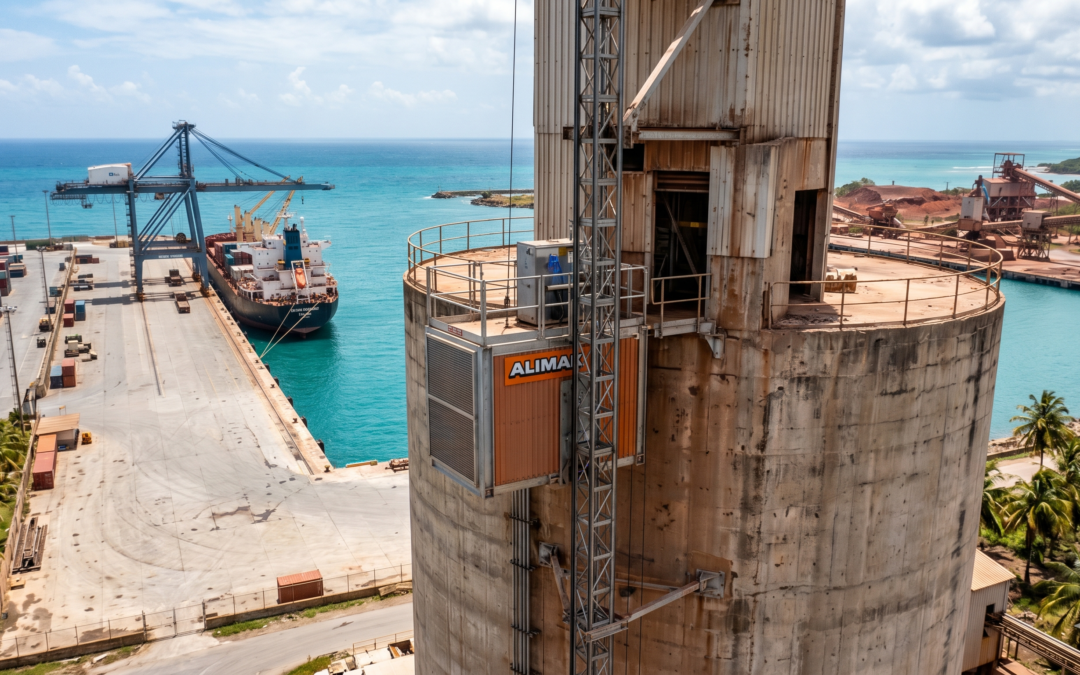
In the Caribbean, industrial elevators operate in conditions that can quickly expose weak specifications. Salt air, tropical humidity, abrasive dust, high temperatures, marine exposure, hurricane season and remote service logistics can turn a basic vertical access decision into a long-term operational risk.
Bridge360 provides Alimak industrial elevator solutions for demanding Caribbean environments, including mines, ports, cement plants, power plants, oil and gas facilities, data centers, logistics sites and heavy industrial operations.
Why does the Caribbean environment require a different industrial elevator specification?
The Caribbean environment requires a different industrial elevator specification because standard elevator systems are not always designed for salt air, abrasive dust, heavy loads, outdoor exposure and continuous industrial use.
Bridge360 identifies high salinity, abrasive dust and extreme duty cycles as major causes of operational shutdowns, project delays and safety risks in the region. Its industrial elevator solutions are built around Alimak rack and pinion technology, which is designed for demanding industrial access applications where uptime and durability matter. (Bridge360)
For facility managers, this means the elevator decision should not start with appearance, cabin finish or lowest initial cost. It should start with the operating environment.
What are the main risks in harsh Caribbean industrial environments?
The main risks are corrosion, abrasive dust, high duty cycles, wind exposure, humidity, limited service access and unplanned downtime. These risks affect different industries in different ways.
- A port may need corrosion-resistant access near saltwater.
- A cement plant may need protection against dust, heat and abrasive particles.
- A mining operation may need rugged vertical access for elevated conveyors, silos and processing structures.
- An oil and gas facility may need hazardous-area planning.
- A power plant may need reliable access for inspection, maintenance and emergency response.
Alimak identifies constant dust particles, extremely high temperatures and humid atmosphere as major challenges for reliable vertical access in cement plant environments. (Alimak)
That is why industrial elevator selection should be treated as an engineering decision, not a simple equipment purchase.
Which factors should you evaluate before choosing an industrial elevator?
You should evaluate seven factors before choosing an industrial elevator: environment, payload, duty cycle, travel height, safety classification, installation constraints and maintenance support. Each factor affects long-term performance.
1. Environment
The first question is where the elevator will operate. A coastal port, bauxite facility, cement plant, offshore platform and data center do not have the same environmental risk.
In the Caribbean, the evaluation should include:
- Salt air exposure.
- Humidity.
- Abrasive dust.
- Outdoor installation.
- Marine exposure.
- Chemical exposure.
- Heat.
- Storm and wind risk.
- Corrosive atmosphere.
If the elevator will operate near the coast, inside a dusty process area or outdoors, corrosion protection and equipment durability become central to the specification. For harsh applications, Bridge360’s Alimak industrial elevators should be used as the main reference point because they are designed for demanding Caribbean operating conditions.
2. Payload capacity
Payload capacity determines how much weight the elevator can move safely. The capacity should include people, tools, replacement parts, materials, pallets and maintenance equipment.
Bridge360’s Alimak industrial elevator portfolio covers several capacity ranges:
- Alimak SE: 300–2,000 kg.
- Alimak SE-H: 2,000–7,000 kg.
- Alimak FM: 5,000–12,000 kg.
- Alimak SE-Ex: for hazardous environments where explosion-protected access may be required.
Bridge360 lists the Alimak SE, SE-H, FM, SE-Ex and SL ranges as part of its industrial elevator portfolio for different industrial applications across the Caribbean. (Bridge360)
Choosing the wrong capacity can increase trips, slow down maintenance work and create safety risks.
3. Duty cycle
Duty cycle refers to how often the elevator operates and how demanding the operating pattern is. A facility that uses the elevator a few times per day does not need the same configuration as a plant where technicians, tools and components move continuously across several shifts.
High-duty operations may include: Power plants, Cement plants, Ports, Mining operations, Oil and gas facilities, Manufacturing sites, and Logistics operations.
If the elevator supports production, inspection, maintenance or emergency access, it should be specified for continuous performance and serviceability.
4. Travel height and landings
Travel height affects elevator configuration, mast requirements, access points and installation planning. The number of landings matters because each landing creates operational and safety requirements. A facility with multiple elevated platforms may require more careful planning than a simple two-level access point.
Before selecting a system, the buyer should define total travel height, number of landings, landing locations, loading points, access restrictions, structural attachment points and future expansion needs.
5. Safety classification
Safety classification becomes critical when the elevator operates in hazardous areas. Oil and gas facilities, refineries, chemical plants, offshore platforms and dusty industrial environments may require special protection depending on the risk of gases, vapors or combustible dust.
Bridge360 offers the Alimak SE-Ex for hazardous environments where explosion-protected access may be required. The SE-Ex page describes the equipment as ATEX and IECEx certified for hazardous environments, including Zone 1, Zone 2, Zone 21 and Zone 22 applications. (Bridge360)
6. Installation constraints
Installation constraints can affect model selection, project timeline and total cost. A facility should evaluate available space, foundation conditions, structural support, power availability, access roads, crane availability, operating shutdown windows, and port or site logistics.
In Caribbean markets, logistics planning is especially important because shipping, customs, technician mobilization and spare parts availability can affect project timing.
7. Maintenance and service support
Maintenance is not optional in harsh environments. An industrial elevator in a port, mine, cement plant or power facility should be supported by preventive maintenance, inspections, genuine parts and trained technicians.
OSHA 1926.552 requires employers to comply with manufacturer specifications and limitations for hoists and elevators. It also states that rated load capacities, recommended operating speeds and special hazard warnings or instructions must be posted on cars and platforms. (Occupational Safety and Health Administration)
Bridge360’s maintenance and services support should be considered before purchase, not after failure. A strong maintenance plan can help reduce downtime, support safety and extend equipment life.
Industrial elevator selection table for Caribbean facilities
| Selection Factor | What to Evaluate | Why It Matters in the Caribbean |
|---|---|---|
| Environment | Salt air, humidity, dust, heat, outdoor exposure | Harsh coastal and industrial conditions can accelerate wear and corrosion |
| Payload | People, tools, parts, pallets, freight | Underestimating load increases trips and operating stress |
| Duty cycle | Daily use, shift pattern, production role | High-use facilities need equipment built for continuous operation |
| Travel height | Total elevation and number of landings | Height and landings affect configuration, safety and installation planning |
| Safety classification | Hazardous gases, vapors, combustible dust | Oil and gas or industrial sites may need explosion-protected systems |
| Installation conditions | Space, structure, power, access and logistics | Poor planning can delay commissioning and increase cost |
| Maintenance support | Inspections, parts, technicians, response time | Local service access reduces downtime risk |
Which Alimak industrial elevator model fits your facility?
The right model depends on the industry, load, environment and safety requirements.
Alimak SE: for modular passenger and freight access
The Alimak SE is a modular industrial elevator designed for passenger and freight transport. It is suitable for facilities that need reliable vertical access for people, tools and materials, with payloads from 300 to 2,000 kg.
Alimak SE-H: for heavy industrial loads
The Alimak SE-H is designed for heavier industrial transport requirements. Bridge360 lists the SE-H with a capacity range of 2,000 to 7,000 kg and positions it for heavy mining, smelters and large infrastructure. (Bridge360)
Alimak FM: for offshore, marine and heavy freight applications
The Alimak FM is designed for offshore, marine and heavy freight applications. Bridge360 lists the FM range with capacity from 5,000 to 12,000 kg and positions it for offshore platforms, ship-to-shore cranes and shipyards. (Bridge360)
Alimak SE-Ex: for hazardous environments
The Alimak SE-Ex is designed for hazardous environments where gases, vapors or combustible dust may create explosion risk. This model should be evaluated for oil and gas facilities, refineries, offshore platforms and industrial zones with specific safety classifications.
Alimak SL: for compact industrial access
The Alimak SL should be considered when the facility needs a compact industrial access solution for limited spaces, silos, monitoring stations or infrastructure applications.
How should buyers choose an industrial elevator by industry?
Buyers should choose an industrial elevator by matching the model to the industry’s operating risk.
- Mining: Prioritize payload, dust protection, elevated maintenance access and uptime. Bridge360 highlights Jamaica as a priority market for mining, cement, data centers and logistics.
- Cement plants: Prioritize dust resistance, heat tolerance, and frequent maintenance access. Alimak identifies dust and high temperatures as major difficulties in cement plant access.
- Ports and shipyards: Prioritize corrosion resistance, heavy freight capacity, and marine exposure planning. Models such as Alimak FM and Alimak SE-H are ideal here.
- Oil and gas facilities: Prioritize hazardous-area requirements and corrosion protection. In Trinidad and Tobago, Bridge360 provides specific solutions for this sector.
- Power plants: Prioritize reliability, emergency access, and long-term maintenance support for boilers, chimneys, and turbine areas.
How does hurricane season affect industrial elevator planning?
Hurricane season affects industrial elevator planning because Caribbean facilities must account for high winds, heavy rain, storm surge risk, power instability and post-storm inspection needs.
The Atlantic hurricane season runs from June 1 through November 30, according to the National Hurricane Center. (nhc.noaa.gov)
Industrial elevator planning should include storm-readiness procedures, power disconnection planning, post-storm inspection steps, emergency access planning, and structural review.
What questions should buyers ask before requesting a consultation?
Useful questions include: What is the maximum payload? How many people will use it? Is the site indoor or outdoor? Is there abrasive dust? Does the site require hazardous-area protection? How many landings and what travel height is needed?
The better question is: “Which elevator will keep this facility operating safely with the lowest downtime risk?”
Why choose Bridge360 for industrial elevator selection?
Bridge360 helps Caribbean facilities choose Alimak industrial elevators based on the real conditions of the site, including environment, payload, duty cycle, and regional service support in Jamaica, Trinidad and Tobago, Barbados and Puerto Rico.
Request an Industrial Elevator Consultation
If your facility operates in a harsh Caribbean environment, choosing the right industrial elevator starts with a technical assessment. Request a consultation to define the right industrial elevator for your facility before corrosion, dust, duty cycle or downtime become a bigger problem.
Frequently asked questions about choosing an industrial elevator
What is the best industrial elevator for harsh environments?
The best industrial elevator is one that matches payload, duty cycle, corrosion exposure, and safety classification. Alimak rack and pinion elevators are designed for these demanding conditions.
What is the best industrial elevator for cement plants?
It should be designed for dust, heat, and frequent maintenance access. Bridge360 provides vertical access solutions for cement plants in Barbados and the wider Caribbean.
What is the best industrial elevator for ports and shipyards?
Evaluate elevators with corrosion-resistant planning and heavy freight capacity, such as the Alimak FM and Alimak SE-H.
When should a facility choose an explosion-protected industrial elevator?
When gases, vapors or combustible dust may be present. The Alimak SE-Ex is designed for these ATEX and IECEx certified environments.
Does Bridge360 support industrial elevator projects across the Caribbean?
Yes, including Jamaica, Trinidad and Tobago, Barbados, Puerto Rico and other regional markets.